Modern Tank Showdown: T-90MS, Leopard 2A7, M1E3 Abrams Compared
Defense Mirror analyzes key capabilities of three latest main battle tanks, including firepower, protection, mobility, technology
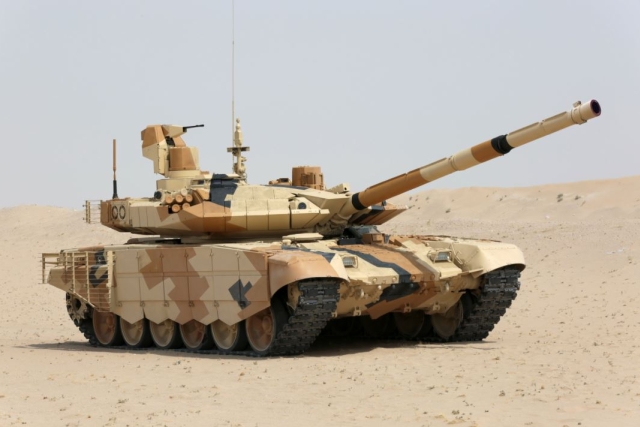
Russia’s T-90MS tank
Main Battle Tanks (MBTs) have shown their mettle in recent conflicts such as in Ukraine despite being increasingly vulnerable to drones and top attack munitions. Defensemirror.com examines three of the world’s leading tanks- the Russian T-90MS, the German Leopard 2A7 and the upcoming American M1E3 Abrams.
Evolution: Legacy platforms, modern redesigns
The T-90MS is a major upgrade of the Soviet-era T-72. Its latest combat configuration, the T-90M, emerged from Russia’s 2010s military modernization drive. The upgrade introduced a redesigned turret, an improved 125 mm smoothbore gun, enhanced fire-control systems, Relikt explosive reactive armor, and updated communications. The MS is the export-standard configuration, incorporating similar improvements.
Germany’s Leopard 2A7 is based on the Leopard 2 platform has undergone multiple upgrades over the past 4 decades. The 2A7 standard emphasizes digital fire control, modular protection, improved thermal imaging, and urban warfare adaptation. Further refinements continue under the 2A7V configuration.
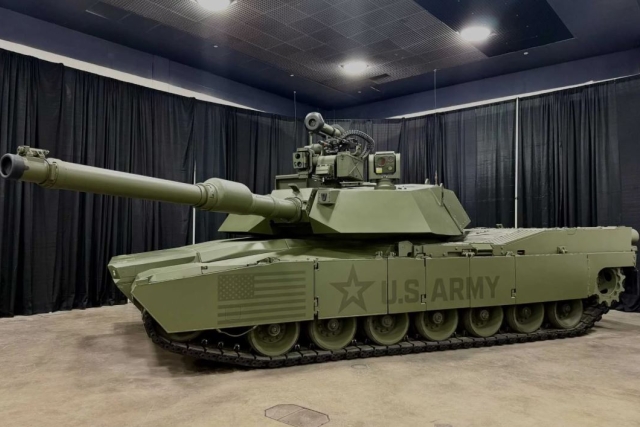
Announced in the 2020s, the M1E3 Abrams aims to reduce combat weight while integrating next-generation survivability systems. Earlier Abrams variants — M1, M1A1, and M1A2 — saw operational deployments in the Gulf War and subsequent conflicts in Iraq and Afghanistan. The M1E3 is intended to incorporate lessons from those deployments into a new architecture.
Firepower: Autoloaders versus crew loaders
The T-90M/MS fields a 125 mm smoothbore gun supported by an autoloader, allowing a three-man crew. It can fire kinetic energy penetrators, high-explosive rounds, and gun-launched anti-tank guided missiles, extending engagement range flexibility.
The Leopard 2A7 employs a NATO-standard 120 mm Rheinmetall smoothbore gun paired with advanced digital fire control. It supports programmable ammunition and kinetic rounds designed for interoperability across NATO forces.
The M1E3 is expected to retain a 120 mm smoothbore cannon but incorporate an autoloader — a departure from previous Abrams designs. Future concepts include AI-assisted targeting and compatibility with next-generation munitions.
Protection and survivability: Weight versus systems
The T-90M combines composite armor with explosive reactive armor and soft-kill countermeasures. Its comparatively lower weight enhances mobility but limits passive armor thickness relative to heavier Western counterparts.
The Leopard 2A7 features modular composite armor with add-on packages tailored to threat environments. It includes nuclear, biological, and chemical protection systems and upgraded crew survivability features for sustained high-intensity operations.
The M1E3 places survivability at the center of its redesign. Planned features include modular armor, integrated active protection systems, and measures to reduce thermal and electronic signatures.
Crew design: Human redundancy or automation?
The T-90M operates with three personnel due to its autoloader. This reduces manpower requirements but limits redundancy if a crew member becomes incapacitated.
The Leopard 2A7 retains a four-person crew with a manual loader. The configuration distributes workload and offers greater operational redundancy.
The M1E3 is expected to feature an unmanned turret with an autoloader, with the crew housed in a protected hull capsule. The design seeks to reduce exposure and rely more heavily on automation.
Networking and digital integration
Modern armored warfare increasingly depends on data integration.
The T-90M includes updated fire control and communications systems. However, its battlefield networking is generally assessed as less extensive than Western digital frameworks.
The Leopard 2A7 integrates established battlefield management systems, advanced thermal optics, and secure communications suited for coordinated NATO operations.
The M1E3 is being designed around an open-architecture digital backbone, enabling integration with drones, artificial intelligence tools, and real-time battlefield data sharing.
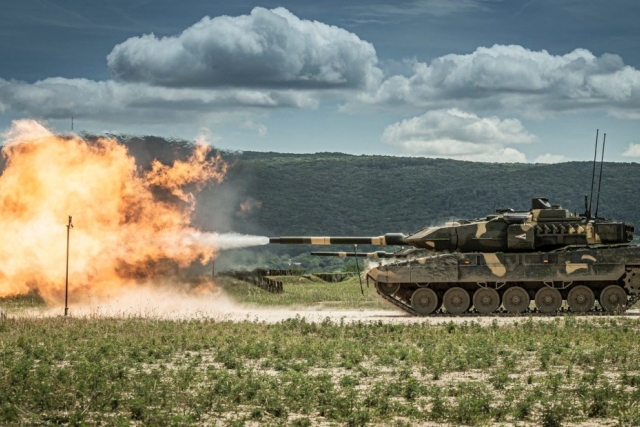
Table comparing the three tanks:
|
Characteristic |
T-90MS / T-90M (Russia) |
Leopard 2A7 (Germany) |
M1E3 Abrams (USA) |
|
Crew |
3 (commander, gunner, driver) |
4 (commander, gunner, loader, driver) |
3 (commander, gunner, driver in hull; turret unmanned) |
|
Main Armament |
125 mm smoothbore w/ autoloader, ATGM capability |
120 mm Rheinmetall L/55 smoothbore |
120 mm M256 smoothbore with autoloader |
|
Secondary Armament |
Remote machine gun(s) |
Coaxial + roof MGs |
RWS with 40 mm, 7.62 mm, anti-tank missile options |
|
Armor Type |
Modular composite + ERA (Relikt/Kontakt/ERA) |
Modular composite armor + add-on kits |
Modular composite, optional DU modules, APS-ready |
|
Weight (approx.) |
≈ 48 t |
≈ 67+ t |
≈ 66 t (target) |
|
Engine / Power |
Diesel ≈ 1,130 hp |
Diesel 1,500 hp |
Gas turbine + planned hybrid/electric variants |
|
Power-to-Weight Ratio |
≈ 23–24 hp/t |
≈ 22–23 hp/t |
Estimated competitive ratio |
|
Top Speed |
≈ 70–72 km/h |
≈ 68–72 km/h |
≈ 68 km/h |
|
Operational Range |
≈ 500–700 km |
≈ 340–450 km (varies w/ load) |
≈ 450–500 km (projected) |
|
Fire Control / Sensors |
Digital FCS, thermal sights, GLONASS/GPS |
Advanced fire control + thermal imaging |
Fully digital MOSA architecture, 360° EO/IR, radar for drones |
|
Protection Suite |
ERA + smoke screen + low silhouette |
High-grade composite, add-on kits |
Integrated modular armor + APS support |
|
Unique Features / Notes |
Autoloader reduces crew; missile firing; compact/lightweight |
Excellent mobility for size; proven digital systems |
Unmanned turret, autoloader, hybrid-drive intent; future-focused design |
Combat experience
Since 2022, T-90M tanks have been used extensively by Russian forces in the Ukraine conflict in offensive and defensive operations. Open-source documentation indicates confirmed battlefield losses from anti-tank guided missiles, artillery, mines, and loitering munitions, alongside instances where upgraded armor and countermeasures mitigated damage. Russia has improved the T-90M from the Ukraine combat experience in terms of an improved front and rear armour, a “barbeque grill” to mitigate FPV drones and top-attack munitions and enhanced crew survivability.
The Leopard 2A7 belongs to the broader Leopard 2 family. Since 2023, Leopard 2 variants, including advanced models supplied by European countries, have been used by Ukrainian forces in combined-arms operations. Documented losses have occurred due to mines, artillery, drones, and anti-tank systems. Operational assessments indicate strong firepower and crew protection, though survivability remains influenced by mine threats and top-attack munitions. During Ukraine’s surprise incursion into Russia’s Kursk region in August 2024, Ukrainian soldiers could be seen riding on Leopard tanks.
The M1E3 Abrams has not yet entered combat. However, earlier Abrams variants (M1, M1A1, M1A2) have been used in the 1991 Gulf War, the 2003 invasion of Iraq. During the Gulf War and initial 2003 Iraq operations, Abrams tanks engaged Iraqi armored forces and were reported to have achieved high kill ratios in conventional armored battles, benefiting from advanced fire control, thermal imaging, and depleted uranium armor packages. Since 2023, M1A1 Abrams tanks supplied to Ukraine have been used in combat, with confirmed losses attributed to mines, drones, and anti-tank guided missiles. Overall effectiveness across conflicts has been closely linked to air superiority, logistics support, crew proficiency, and integration within combined-arms operations.
Conclusion:
All three tanks have undergone extensive combat experience and have their share of advantages and vulnerabilities.
The Russian T-90MS stands out for its substantially lighter weight (48 tons) compared to the Leopard 2A7 (67 tons) and Abrams M1E3 (66 tons-expected).
This gives it a higher power to weight ratio of 23–24 hp/t compared to 22–23 hp/t for the Leopard and probably similar for the Abrams which is still under development.
The T-90MS has a 125mm main gun with auto-loader and ATGM capability while its two competitors have a 120 mm gun with largely similar capabilities.
The lower weight of the T-90MS makes it more maneuverable thereby suitable for rapid movement across open fields as well as urban areas.
The T-90MS has a 1130HP engine compared to the 1500HP engine of the Leopard 2A7. On paper this may appear to be a disadvantage but it makes it more fuel efficient and gives it a higher range of 500–700 km compared to 340–450 km for the Leopard.
In terms of price, the T-90MS is the clear winner here with an estimated price of $7-10 million as compared to the $25-27 million for the Leopard 2A7 and similar or more for the American tank.

Egypt Chooses Russian Antey-2500, KA-52 Helicopters to Guard its New “Octagon” Military...

NATO Special Forces Select Thales-Leonardo Consortium to Deliver Communication System
Ukraine Blames Lack of Patriot Interceptors as Russian Missiles Rain Down on...
Ammunition Factory of Indonesian PT Pindad Breaks Ground

One Month Since U.S., Israeli War Against Iran: Who Is Gaining?
One month after the United States and Israel launched coordinated strikes on Iran on February 28 the conflict has expanded...
Modern Tank Showdown: T-90MS, Leopard 2A7, M1E3 Abrams Compared
Main Battle Tanks (MBTs) have shown their mettle in recent conflicts such as in Ukraine despite being increasingly vulnerable to...
European Nations Prioritizing Europe-made IRIS-T & SAMP-T over American Patriot Air Defense Systems?
European nations looking to procure new air defense systems appear to be giving the much-vaunted American Patriot a miss in...
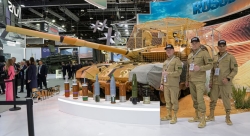
Russian T-90MS Crew Discuss Future Upgrades
Defense Mirror spoke with the crew members of the Russian T-90MS main battle tank, produced by UralVagonZavod

China's Mass-produced J-35A Aircraft Set to Disrupt Global Stealth Fighter Market
China is aiming to disrupt the global stealth fighter market by mass-producing its fifth-generation J-35A at a pace comparable to...
The Future of Combat: Miniaturized Laser Weapons Set to Replace Bullets and Missiles
Lasers may soon replace bullets, and drones could disable enemy UAVs with beams of light instead of missiles