New AESA Radar to Add Teeth to Russian Attack Helicopters
The Arbalet-AM radar makes use of artificial intelligence to identify air and ground targets in near-real time.
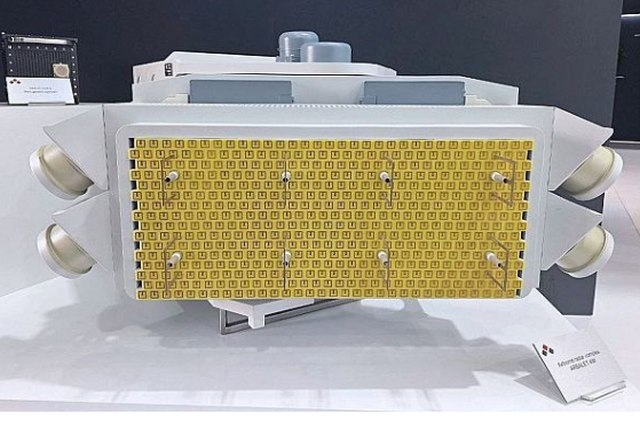
Russia’s Radio-Electronic Technologies (KRET) debuted the Arbalet-AM multi-mode airborne radar system (ARS) at the Dubai Airshow designed for installation on helicopters and fixed-wing aircraft.
The system is equipped with an active phased array (AESA) radar, which provides enhanced stealth in LPI mode and stable target tracking in challenging jamming environments. The use of artificial intelligence improves the accuracy of recognition of air, ground, and sea targets.
A synthetic aperture mode for detecting and classifying ground targets has also been implemented. The parameters of this radar system are close to those of the Rezets radar system, integrated into the weapons control system of the Ka-52M reconnaissance and attack helicopters.
A key feature is the ability to control unmanned aerial vehicles using a narrow beam, which increases the communication channel's resistance to jamming.
According to the developers, the system helps reduce crew decision-making time and ultimately significantly improves the survivability and effectiveness of combat aircraft.

The Rezets radar was announced in 2019 and has features such as a fixed 900×300 mm AESA antenna with 640 transceiver modules.
It can detect a group of tanks from 45 km, a railway bridge from 100 km, and a destroyer-class warship from 150 km, according to the manufacturer.
In the air-to-air mode, it can detect a fighter aircraft with a radar cross section of 3 sq m from up to 50 km head-on and a hovering helicopter from 20 km.
The Rezets radar weighs 130 kg, 10 kg less than the current Ka-52's FH01 produced by Phazotron-NIIR of Moscow, and is air-cooled, with an air scoop for cooling seen on the helicopter's nose fairing.
It is not yet known if the Arbalet-AM will replace the Rezets radar system or is meant for only helicopters marked for specialist missions.
Extended Range Russian 'Khrizantema' Air-to-Ground Missile Debuts on Ka-52M, Mi-28NM Helicopters...

Export Variants of Russia’s Mi-28NM, Ka-52M Helos to Get All New Multi-Purpose...
AESA Radar, Guided Missiles in Upgraded Russian KA-52M Helicopter
Ukraine Pulls Off World’s First Unmanned Amphibious Assault

IRGC Strikes Two Super Tankers in Strait of Hormuz, 5 Killed in...

Houtis Fire Missiles at Saudi Airport after Riyadh Bombs Yemen’s Sanaa Airport...

Iran Blockade Back, Now U.S. to Charge 20% Hormuz Transit Fee

One Month Since U.S., Israeli War Against Iran: Who Is Gaining?
One month after the United States and Israel launched coordinated strikes on Iran on February 28 the conflict has expanded...
Modern Tank Showdown: T-90MS, Leopard 2A7, M1E3 Abrams Compared
Main Battle Tanks (MBTs) have shown their mettle in recent conflicts such as in Ukraine despite being increasingly vulnerable to...
European Nations Prioritizing Europe-made IRIS-T & SAMP-T over American Patriot Air Defense Systems?
European nations looking to procure new air defense systems appear to be giving the much-vaunted American Patriot a miss in...
Russian T-90MS Crew Discuss Future Upgrades
Defense Mirror spoke with the crew members of the Russian T-90MS main battle tank, produced by UralVagonZavod

China's Mass-produced J-35A Aircraft Set to Disrupt Global Stealth Fighter Market
China is aiming to disrupt the global stealth fighter market by mass-producing its fifth-generation J-35A at a pace comparable to...

The Future of Combat: Miniaturized Laser Weapons Set to Replace Bullets and Missiles
Lasers may soon replace bullets, and drones could disable enemy UAVs with beams of light instead of missiles