Argentina Unveils First F-16 Fighter Jets Procured from Denmark
The transfer is part of a 24-jet package approved by U.S. in 2023 and finalized with Denmark in 2024.
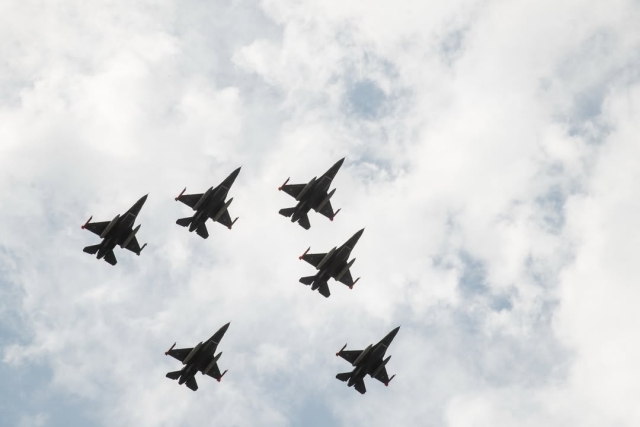
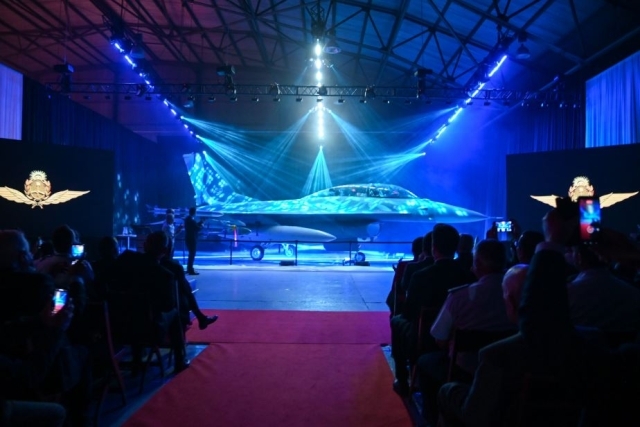
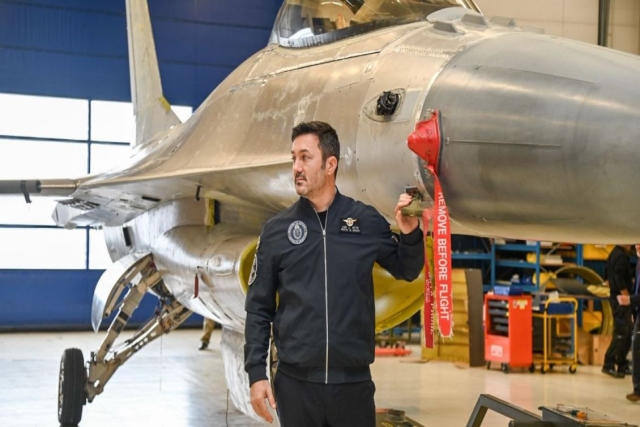
Argentina presented its first six F-16 fighter jets on December 7, with President Javier Milei and Defense Minister Luis Petri leading the ceremony in Buenos Aires.
The aircraft—acquired from Denmark—mark Argentina’s return to supersonic fighter capability after a decade of absence.
The jets arrived on Saturday following a four-leg transatlantic ferry flight supported by U.S. Air Force KC-135 tankers. Four two-seat F-16Bs and two single-seat F-16As completed the journey from Denmark via Spain, the Canary Islands, and Brazil before landing in Río Cuarto, where Milei and Petri received them.
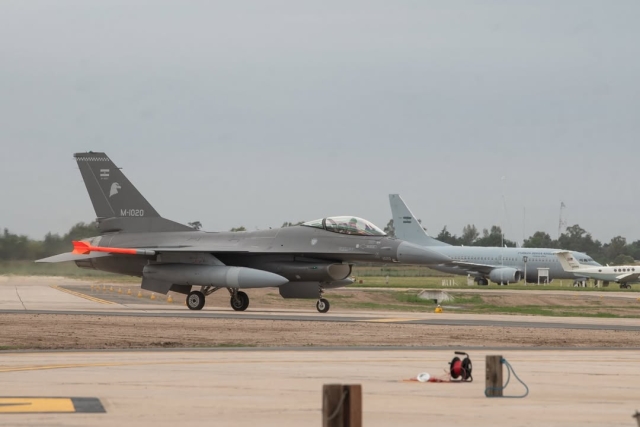
Ahead of the ceremony, the F-16s conducted a low-level flyover of Buenos Aires between 8:00 and 8:45 a.m., passing Casa Rosada, Avenida de Mayo, Avenida 9 de Julio, the Río de la Plata, Aeroparque Jorge Newbery, and Puerto Madero before returning to Río Cuarto.
Argentina’s defense ministry describes the F-16 deal as the country’s most consequential military purchase in 40 years. The transfer is part of a 24-jet package approved by U.S. in 2023 and finalized with Denmark in 2024. The remaining aircraft will arrive in three batches, with the final delivery expected in December 2028. The fighters will operate initially from Río Cuarto before relocating to a permanent base in Tandil.
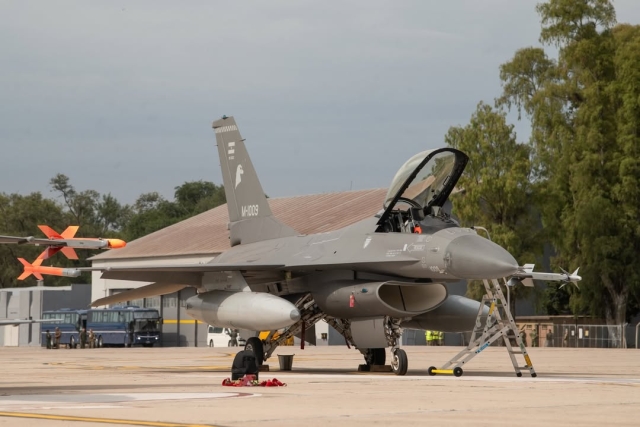
The U.S. has also confirmed a $40 million Foreign Military Financing grant to support a broader $560 million training and sustainment package. It did not clarify whether the transfer includes weapons. A previously approved but incomplete Foreign Military Sales request covered AIM-120C-8 air-to-air missiles, Mk82 bombs, and GBU-12 Paveway II guided bombs.
The F-16s restore capabilities lost since the retirement of Mirage III jets in 2015. For decades, Buenos Aires attempted to acquire new fighters—including Gripens, Kfirs, and FA-50s—but was blocked by British restrictions on components such as ejection seats and avionics following the 1982 Falklands War. The Danish transfer proceeded because the F-16 uses an American-made ACES II ejection seat.
Argentina to Receive F-16 Aircraft Procured from Denmark Soon
Argentina Signs F-16 Electronic Warfare Upgrade Deal With Terma

70 Civilians killed, 360 Injured in Ukrainian Strikes on Russian Economic Targets

Hand to Hand Combat Between Chinese, Philippine Soldiers in South China Sea

2 US troops KILLED, 1 Missing, 4 Injured in Iran Missile Strikes

Russia's Unmanned Systems Group Signs Several International Contracts to Sell its Supercam...

One Month Since U.S., Israeli War Against Iran: Who Is Gaining?
One month after the United States and Israel launched coordinated strikes on Iran on February 28 the conflict has expanded...
Modern Tank Showdown: T-90MS, Leopard 2A7, M1E3 Abrams Compared
Main Battle Tanks (MBTs) have shown their mettle in recent conflicts such as in Ukraine despite being increasingly vulnerable to...
European Nations Prioritizing Europe-made IRIS-T & SAMP-T over American Patriot Air Defense Systems?
European nations looking to procure new air defense systems appear to be giving the much-vaunted American Patriot a miss in...
Russian T-90MS Crew Discuss Future Upgrades
Defense Mirror spoke with the crew members of the Russian T-90MS main battle tank, produced by UralVagonZavod

China's Mass-produced J-35A Aircraft Set to Disrupt Global Stealth Fighter Market
China is aiming to disrupt the global stealth fighter market by mass-producing its fifth-generation J-35A at a pace comparable to...
The Future of Combat: Miniaturized Laser Weapons Set to Replace Bullets and Missiles
Lasers may soon replace bullets, and drones could disable enemy UAVs with beams of light instead of missiles