U.S.A.F.’s B-52 Bomber Completes Ferry Flight after AESA Radar Upgrade
The fleet of 76 B-52s is also set to receive new engines, upgraded communication systems, revised avionics, and weapons improvements.
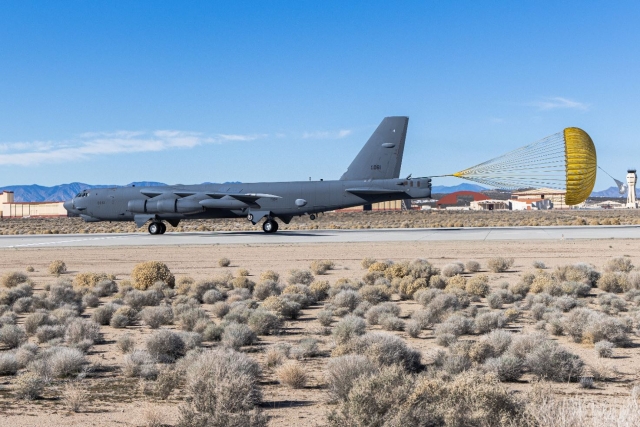
A B-52 Stratofortress has arrived at Edwards Air Force Base, California, after completing its ferry flight from Boeing’s San Antonio facility with a newly installed radar under the B-52 Radar Modernization Program.
The flight marks a central step in U.S. efforts to ensure the long-range bomber remains viable for both conventional and nuclear missions, the service said in a statement today.
A crew from the 49th Test Evaluation Squadron at Barksdale Air Force Base, Louisiana, and the 419th Flight Test Squadron at Edwards moved the aircraft on December 8. Ground and flight testing will continue through 2026, supporting a production decision later that year.
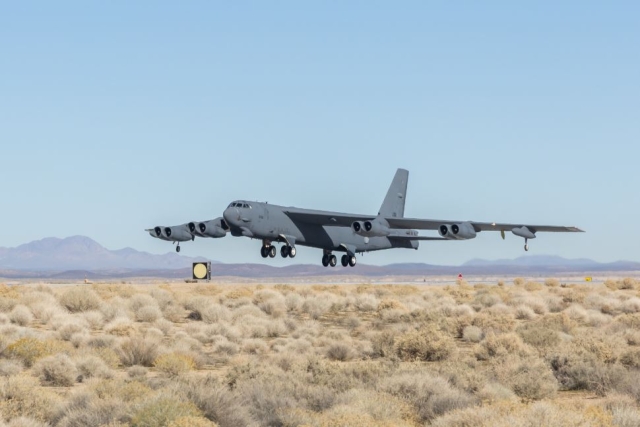
The modern Active Electronically Scanned Array (AESA) radar system replaces the aircraft's antiquated and failing legacy radar, providing an upgraded all-weather navigation and targeting capability for the 65-year-old strategic bomber to ensure its future effectiveness. The AESA radar, developed by Raytheon Technologies, and integrated into the B-52 by Boeing, follows successful radar upgrades on the U.S. Air Force F-15 and the U.S. Navy F/A-18, and will bring a similar level of capability and maintainability to the venerable B-52.
The radar effort is part of the wider plan to keep the B-52 in service through 2050 and potentially beyond, operating alongside the B-21 Raider. The fleet of 76 aircraft is also set to receive new engines, updated crew stations, conventional and nuclear communication systems, revised avionics, weapons upgrades, and other mission-critical improvements.
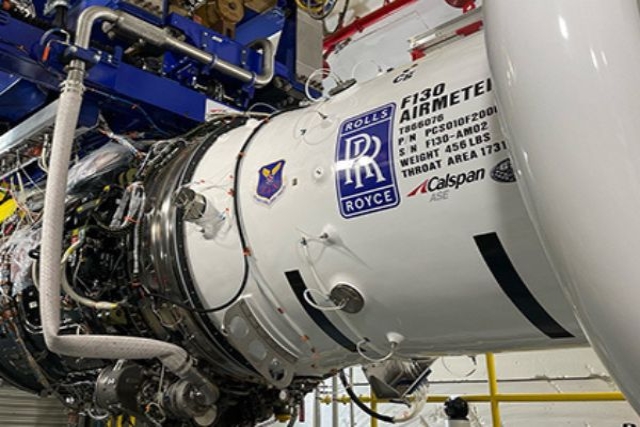
Rolls-Royce holds F130 Engine Critical Design Review for the U.S. Air Force...

U.S.A.F. Strikes ISIS in Syria Using B-52 Bombers, F-15 Fighters...

L3Harris Tests Upgraded Line Replaceable Units in B-52 Electronic Warfare System

L3Harris to Merge B-52H Bomber’s Electronic Warfare Officer and Navigator Positions...

70 Civilians killed, 360 Injured in Ukrainian Strikes on Russian Economic Targets

Hand to Hand Combat Between Chinese, Philippine Soldiers in South China Sea
2 US troops KILLED, 1 Missing, 4 Injured in Iran Missile Strikes
Russia's Unmanned Systems Group Signs Several International Contracts to Sell its Supercam...

One Month Since U.S., Israeli War Against Iran: Who Is Gaining?
One month after the United States and Israel launched coordinated strikes on Iran on February 28 the conflict has expanded...
Modern Tank Showdown: T-90MS, Leopard 2A7, M1E3 Abrams Compared
Main Battle Tanks (MBTs) have shown their mettle in recent conflicts such as in Ukraine despite being increasingly vulnerable to...
European Nations Prioritizing Europe-made IRIS-T & SAMP-T over American Patriot Air Defense Systems?
European nations looking to procure new air defense systems appear to be giving the much-vaunted American Patriot a miss in...
Russian T-90MS Crew Discuss Future Upgrades
Defense Mirror spoke with the crew members of the Russian T-90MS main battle tank, produced by UralVagonZavod

China's Mass-produced J-35A Aircraft Set to Disrupt Global Stealth Fighter Market
China is aiming to disrupt the global stealth fighter market by mass-producing its fifth-generation J-35A at a pace comparable to...

The Future of Combat: Miniaturized Laser Weapons Set to Replace Bullets and Missiles
Lasers may soon replace bullets, and drones could disable enemy UAVs with beams of light instead of missiles