U.S. Naval Research Lab using AI & Hyperspectral Imaging to Enhance Stealth of Warship
Hyperspectral imaging combined with AI aims to mask naval vessels in cluttered coastal environments.
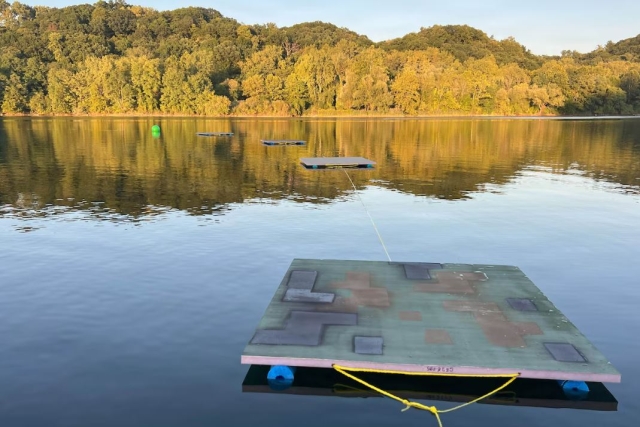
The U.S. Naval Research Laboratory (NRL) is developing artificial intelligence applications in hyperspectral imaging to enhance the stealth coat of warships to avoid detection by advanced (enemy) surveillance systems.
The technology "significantly improves our ability to detect and identify objects in crowded littoral zones," NRL researcher Katrina Doctor said, adding that improved hyperspectral detection is key to assessing threats and ensuring the (U.S) Navy maintains a clear operational advantage in any coastal environment.
Hyperspectral imaging, often described as capturing "the color of color," provides a unique spectral fingerprint for each pixel. Combined with AI, these fingerprints support powerful tools for detecting subtle material differences and observing environmental change.
The NRL is leveraging multiscale data collected from airborne platforms, unmanned aerial vehicles and satellites over engineered and natural targets at the Tait Preserve in Penfield, New York — an environment chosen for its coastal and aquatic-adjacent features.
Researchers collected measurements from custom-fabricated metal panels with painted coatings, as well as from natural rock and mineral samples. These targets serve as known reference points — like the bull's-eye on a target — for improving AI algorithms that solve a longstanding remote sensing challenge called hyperspectral unmixing.
Hyperspectral unmixing is the process of separating mixed spectral signatures within a single pixel. When unresolved, mixed pixels can obscure object detection and reduce identification accuracy — especially in complex, cluttered coastal environments.
Researchers collected measurements from custom-fabricated metal panels with painted coatings, as well as from natural rock and mineral samples. These targets serve as known reference points — like the bull's-eye on a target — for improving AI algorithms that solve a longstanding remote sensing challenge called hyperspectral unmixing.
The resulting AI systems will be better able to distinguish between natural environments, like the ocean surface, and coated, fabricated objects, like a ship's hull. The approach provides reference points for evaluating how AI-based unmixing performs across varying environmental and spectral conditions.

Eurofighter to Receive New AI-Driven Electronic Warfare System under Helsing–Saab Contract

Flying Wedge Unveils India’s First AI-Powered MALE Combat Aircraft, Secures $30M Export...

Lockheed Martin Tests AI-Powered Radar to Autonomously Track Maritime Targets

Baykar’s Akinci Drone Fires AI-enabled Mini Cruise Missile

US Warships Forced to Retreat after Iranian Navy Fires Warning Shots in...

Ukraine Struck 18 Russian Oil Facilities in May, the Farthermost being 1700...
After Australia, Korea Next in Line to Acquire Nuclear-powered Submarines

Missed Patriot Interceptor, Not Iranian Drone Hit Kuwait Airport

One Month Since U.S., Israeli War Against Iran: Who Is Gaining?
One month after the United States and Israel launched coordinated strikes on Iran on February 28 the conflict has expanded...

Modern Tank Showdown: T-90MS, Leopard 2A7, M1E3 Abrams Compared
Main Battle Tanks (MBTs) have shown their mettle in recent conflicts such as in Ukraine despite being increasingly vulnerable to...

European Nations Prioritizing Europe-made IRIS-T & SAMP-T over American Patriot Air Defense Systems?
European nations looking to procure new air defense systems appear to be giving the much-vaunted American Patriot a miss in...

Russian T-90MS Crew Discuss Future Upgrades
Defense Mirror spoke with the crew members of the Russian T-90MS main battle tank, produced by UralVagonZavod

China's Mass-produced J-35A Aircraft Set to Disrupt Global Stealth Fighter Market
China is aiming to disrupt the global stealth fighter market by mass-producing its fifth-generation J-35A at a pace comparable to...

The Future of Combat: Miniaturized Laser Weapons Set to Replace Bullets and Missiles
Lasers may soon replace bullets, and drones could disable enemy UAVs with beams of light instead of missiles