Iran Could Reverse-engineer Unexploded Tomahawk Missiles, GBU-57 Bombs
Unexploded U.S. munitions recovered from strikes on Iranian nuclear sites fuel fears Tehran could gain sensitive weapons technology

Iran could gain access to sensitive American weapons technology after unexploded Tomahawk cruise missiles and the GBU-57 Massive Ordnance Penetrator bunker-busting bomb were recovered by it following recent strikes on Iranian nuclear facilities.
As per unconfirmed reports, the country’s foreign minister reportedly said that some weapons failed to detonate and are now in Iranian custody. Such unexploded munition have intact components, including guidance, navigation, and sensor suites. These can be studied and reverse-engineered to extract technical insights.
Recovery efforts by the U.S. after conflicts or strikes aim to secure such weapons before rivals do, drawing on lessons from Syria in 2018, where Russia allegedly examined unexploded Tomahawk missiles.
Tehran has previously taken similar opportunities to study foreign systems. Back in 2011, Iran captured a Lockheed Martin RQ-170 Sentinel stealth reconnaissance drone after it entered Iranian airspace. It subsequently developed Iranian variants such as the Shahed-171 Simorgh based on that design. An Iranian derivative, the Saegheh, was reported shot down over Syrian airspace in 2018. Israel claimed that its design bore similarities to the original RQ-170.
Iran has also reverse-engineered older Western weapons such as the BGM-71 TOW anti-tank guided missile (Toophan), U.S. ScanEagle reconnaissance drone (Qods Yasir UAV), etc.

Iran Test-Launches Khorramshahr 4 Hypersonic Missile with 2-Ton Warhead

Iran Receives its First Mi-28NE Night Hunter Helicopter from Russia: Reports

U.S. Shoots down Iranian Drone near Aircraft Carrier in Arabian Sea

As Protests Subside, Iran Claims Crushing Several Foreign-backed Terror Cells

IRGC Strikes Two Super Tankers in Strait of Hormuz, 5 Killed in...
Houtis Fire Missiles at Saudi Airport after Riyadh Bombs Yemen’s Sanaa Airport...

Iran Blockade Back, Now U.S. to Charge 20% Hormuz Transit Fee
First Use of Unmanned Kamikaze Boat by the U.S. in Attack...

One Month Since U.S., Israeli War Against Iran: Who Is Gaining?
One month after the United States and Israel launched coordinated strikes on Iran on February 28 the conflict has expanded...
Modern Tank Showdown: T-90MS, Leopard 2A7, M1E3 Abrams Compared
Main Battle Tanks (MBTs) have shown their mettle in recent conflicts such as in Ukraine despite being increasingly vulnerable to...
European Nations Prioritizing Europe-made IRIS-T & SAMP-T over American Patriot Air Defense Systems?
European nations looking to procure new air defense systems appear to be giving the much-vaunted American Patriot a miss in...
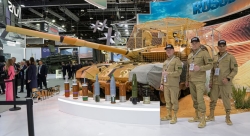
Russian T-90MS Crew Discuss Future Upgrades
Defense Mirror spoke with the crew members of the Russian T-90MS main battle tank, produced by UralVagonZavod

China's Mass-produced J-35A Aircraft Set to Disrupt Global Stealth Fighter Market
China is aiming to disrupt the global stealth fighter market by mass-producing its fifth-generation J-35A at a pace comparable to...

The Future of Combat: Miniaturized Laser Weapons Set to Replace Bullets and Missiles
Lasers may soon replace bullets, and drones could disable enemy UAVs with beams of light instead of missiles