Iranian MiG-29A, Yak-130 Jets Seen over Tehran Engaging Israeli, U.S. Missiles, Drones
The flight of Iranian jets busts claims of airspace dominance by Israeli, U.S. Air Forces
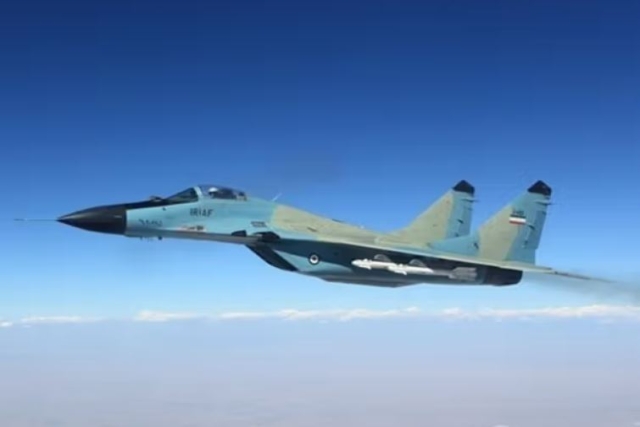
Iranian MiG-29A multirole fighters and Yak-130 combat trainer aircraft have been observed flying over Tehran, hinting at their potential role in countering Israeli and U.S. aerial threats, including drones and cruise missiles.
According to the Russian Arms Telegram channel, experts estimate that the aircraft could be tasked with intercepting various airborne threats, including LUCAS kamikaze drones, heavy Israeli reconnaissance and strike drones, and potentially Tomahawk cruise missiles. The deployment of LUCAS drones in the region has previously been confirmed by the U.S. Central Command.
The MiG-29A is reportedly equipped with the export variant of the Soviet-designed N019 Rubin radar, the N019EA, and can carry R-27R air-to-air missiles. Its primary short-range interceptor weapon may be the R-73RMD-2 air-to-air missile fitted with a dual-band MK-80 Mayak infrared homing seeker. In 2022, the Iranian Air Force reported destroying a TDU-11B aerial target simulating a cruise missile during a test, demonstrating the missile system’s interception capability. The Yak-130 combat trainer is also assessed to have comparable interception functions against aerial targets.
The capabilities of the MiG-29A differ significantly from those of modern U.S. aircraft such as the F-22A Raptor, which uses the AN/APG-77 radar, and the F/A-18E/F Super Hornet equipped with the AN/APG-79 radar and AIM-120D long-range missiles. However, for rear-area air defense missions involving low-flying subsonic targets, existing Iranian platforms may be operationally sufficient.
A cited advantage of the MiG-29A in such missions is its OEPrNK-29E electro-optical targeting system, which enables detection of heat-contrast targets, including cruise missiles, from the rear hemisphere.
The visible presence of Iranian combat aircraft over interior airspace reflects operational constraints faced by U.S. and Israeli aircraft in certain areas. Iran’s mountainous terrain continues to provide concealment for mobile crews operating anti-aircraft missile systems affiliated with the Islamic Revolutionary Guard Corps, creating persistent risks for hostile aircraft and opening limited maneuver windows for the Iranian Air Force to conduct air defense operations deeper inside the country.

Israel and U.S. Bombing Of Iranian School a Grave Violation of Humanitarian...

Qatar, U.A.E. Intercept over 200 Iranian Missiles, Drones; Shoot Down 2 Su-24...

China Supports Iran in Safeguarding Sovereignty, Territorial Integrity: Beijing

Iranian Tactics More Effective Now Than in June 2025
Turkey to Sell Russian S-400 Systems to Third Country as GE Engine...
Pentagon Awards Contracts to Develop Laser Weapons Against Cruise Missiles, Drones

Iran Threatens to Close Strait of Hormuz as US Signals Return to...
China-made Aircraft Fly in U.S. Airshow for First Time

One Month Since U.S., Israeli War Against Iran: Who Is Gaining?
One month after the United States and Israel launched coordinated strikes on Iran on February 28 the conflict has expanded...
Modern Tank Showdown: T-90MS, Leopard 2A7, M1E3 Abrams Compared
Main Battle Tanks (MBTs) have shown their mettle in recent conflicts such as in Ukraine despite being increasingly vulnerable to...
European Nations Prioritizing Europe-made IRIS-T & SAMP-T over American Patriot Air Defense Systems?
European nations looking to procure new air defense systems appear to be giving the much-vaunted American Patriot a miss in...

Russian T-90MS Crew Discuss Future Upgrades
Defense Mirror spoke with the crew members of the Russian T-90MS main battle tank, produced by UralVagonZavod

China's Mass-produced J-35A Aircraft Set to Disrupt Global Stealth Fighter Market
China is aiming to disrupt the global stealth fighter market by mass-producing its fifth-generation J-35A at a pace comparable to...

The Future of Combat: Miniaturized Laser Weapons Set to Replace Bullets and Missiles
Lasers may soon replace bullets, and drones could disable enemy UAVs with beams of light instead of missiles