North Korea May Have Earned $14.4B from Arms, Troop Supply to Russia
Report links troop deployments, weapons shipments to billions in potential revenue for Pyongyang during Ukraine war.
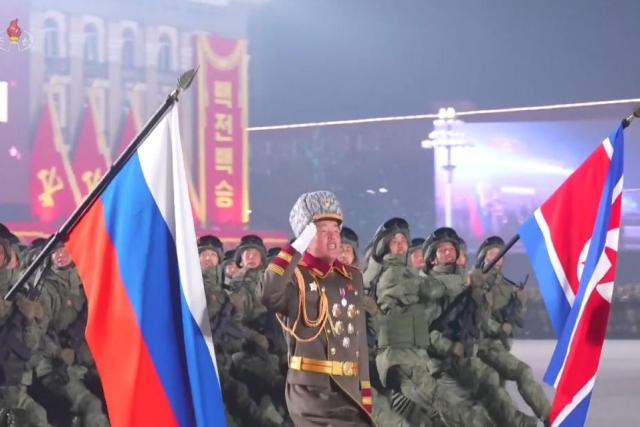
North Korea may have earned up to $14.4 billion from deploying troops and exporting military equipment to Russia during the war in Ukraine, according to a report published on March 13 by the Seoul-based National Security Strategy Institute.
The analysis examined military cooperation between Pyongyang and Moscow since 2023 and assessed that payments linked to troop deployments and arms exports could increase North Korea’s foreign currency inflows, potentially weakening the economic impact of international sanctions.
According to the study, North Korea began sending military personnel to Russia in October 2024, carrying out four deployments. It estimated that more than 20,000 personnel, including combat troops and engineering units, were sent.
Satellite imagery and open-source data cited in the report indicate that North Korea supplied military equipment to Russia before and during these deployments. Shipments reportedly included artillery ammunition, multiple rocket launcher systems, self-propelled artillery systems, and ballistic missiles transported in containers.
Unconfirmed reports indicate deliveries of 8 million to 15 million artillery shells to Russia through a covert maritime network. Supplies are said to include KN-23 (Hwasong-11A) ballistic missiles, M-1989 Koksan self-propelled howitzers, and short-range missile systems.
Lim Soo-ho, a senior research fellow at the National Security Strategy Institute, presented the findings in a report titled “The Economic Impacts of North Korea’s Troop Deployment and Military Equipment Exports to Russia.”
Lim wrote: “If North Korea fully collects payments for troop deployments and arms exports, the primary economic effect of sanctions against North Korea—reducing foreign exchange inflows—will be rendered ineffective.”
The study estimated that total revenue generated between August 2023 and December 2024 ranged from $7.67 billion to $14.4 billion.
Direct revenue linked to troop deployments alone, including salaries and death benefits, was estimated at around $620 million, while the report said North Korea could generate approximately $560 million annually from such deployments under current arrangements.
The report noted that only a limited portion of the estimated revenue has been verified. According to Lim, verified payments represent between 4% and 19.6% of the total estimated value.
Lim stated: “Verified payments are limited to physical goods that can be easily observed visually or via satellite.”
He added: “It is assessed that the vast majority of payments for troop deployment and arms exports have been, or are highly likely to be, received in the form of sensitive military technologies or related high-precision components and materials that are difficult to detect by satellite.”
Satellite imagery and shipment records have shown container movements between North Korean and Russian ports, which analysts say may be linked to the transfer of artillery ammunition and other military equipment.
The U.K. Ministry of Defence and other intelligence sources estimate that over 6,000 North Korean personnel were killed or wounded as of mid-2025.
Beyond combat troops, North Korea is also reported to have deployed thousands of workers, with estimates ranging from 10,000 to 50,000, for construction, demining, and reconstruction in Russian-held territories.

North Korean Artillery Crews, Drone Operators Integrated into Russian Units after Kursk...

Russia to Train North Korean Specialists in Uranium Exploration
North Korea to Send 1,000 Sappers to Demine Russia's Kursk Region
US Warships Forced to Retreat after Iranian Navy Fires Warning Shots in...
Ukraine Struck 18 Russian Oil Facilities in May, the Farthermost being 1700...
After Australia, Korea Next in Line to Acquire Nuclear-powered Submarines
Missed Patriot Interceptor, Not Iranian Drone Hit Kuwait Airport

One Month Since U.S., Israeli War Against Iran: Who Is Gaining?
One month after the United States and Israel launched coordinated strikes on Iran on February 28 the conflict has expanded...
Modern Tank Showdown: T-90MS, Leopard 2A7, M1E3 Abrams Compared
Main Battle Tanks (MBTs) have shown their mettle in recent conflicts such as in Ukraine despite being increasingly vulnerable to...
European Nations Prioritizing Europe-made IRIS-T & SAMP-T over American Patriot Air Defense Systems?
European nations looking to procure new air defense systems appear to be giving the much-vaunted American Patriot a miss in...
Russian T-90MS Crew Discuss Future Upgrades
Defense Mirror spoke with the crew members of the Russian T-90MS main battle tank, produced by UralVagonZavod
China's Mass-produced J-35A Aircraft Set to Disrupt Global Stealth Fighter Market
China is aiming to disrupt the global stealth fighter market by mass-producing its fifth-generation J-35A at a pace comparable to...
The Future of Combat: Miniaturized Laser Weapons Set to Replace Bullets and Missiles
Lasers may soon replace bullets, and drones could disable enemy UAVs with beams of light instead of missiles