Rheinmetall Likely to Receive German Army’s Euro 2.4 Billion Loitering Munitions Contract
This is the German Army's third big contract for loitering munitions in recent years
The Budget Committee (BMVg) of the German Army on April 15 approved a third framework agreement on the procurement of loitering ammunition systems (LMS).
The manufacturer is likely to be Rheinmetall with with a framework agreement of up to almost 2.4 billion euros may now be concluded, German media reported. In a first step, a firm order of almost 300 million euros will likely be placed.
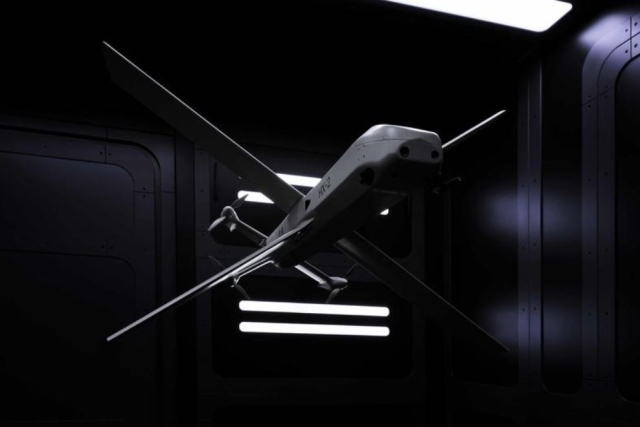
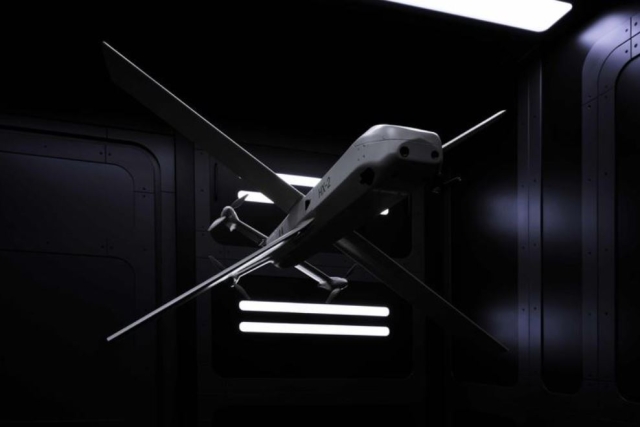
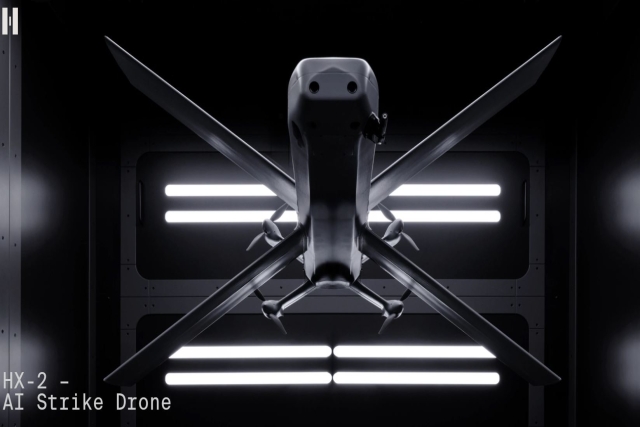
Earlier reports said that the German companies- Helsing and STARK were selected for previous contracts of loitering munitions. These companies produce the HX-2 and OWE-V systems respectively, both loitering munitions with a range of up to 100km.
Rheinmetall is to supply around 2,500 FV-014 strike drones to the Bundeswehr.
According to the ministry, the benchmark for all manufacturers was that the required maturity and quality of the products had been proven in in-house and Bundeswehr-internal qualification and test procedures (proof of concept).
The remaining residual risk is hedged by the contractual agreement of demolition milestones. The contract thus grants the client a unilateral right of withdrawal if the required proof of qualification is not achieved. Innovation clauses also ensure continuous technological development or adaptation of the LMS.
According to the BMVg, the parallel commissioning of three manufacturers pursues several goals: Provision is made in the event that individual manufacturers do not reach series production. Systems with different capabilities are procured, which expands the scope of action of commanders and increases flexibility and assertiveness against actions of a possible adversary.
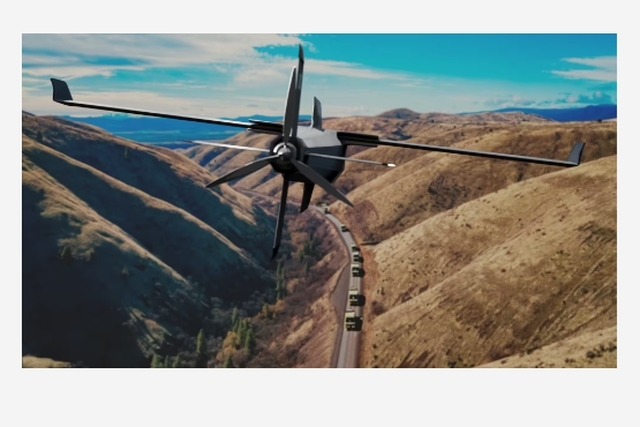
FV-014 Loitering munition
Accordinvg to Rheinmetall information, the FC-014 loitering munition can observe and analyse targets before striking with precision at the right moment. The operator remains engaged in the decision-making process at all times. In this way, the system helps to minimise collateral damage, protect friendly forces and engage critical threats quickly, in a precise and effective manner.
The system is designed to allow a single operator to control multiple LMSs simultaneously. The software architecture enables coordinated control, communication and mission planning of multiple platforms in real time. Automated routines throughout the entire chain of action – from navigation to target identification and prioritisation and combating
Ukraine to Receive 6,000 AI Powered Kamikaze Drones from German Firm, Helsing
Germany’s Helsing Produces AI-Powered HX-2 Drones for Ukraine

A Bridge for a Cargo Ship- Trump Announces Tit-for-Tat Attacks Against Iran
Cyber warfare against Russia? SSL Certificates of Many Government, Media Websites Revoked
Combat Trainer Crashes in Russia, Pilot Ejects

Chinese Factory Leads the World in Mass-Production of Satellites

One Month Since U.S., Israeli War Against Iran: Who Is Gaining?
One month after the United States and Israel launched coordinated strikes on Iran on February 28 the conflict has expanded...
Modern Tank Showdown: T-90MS, Leopard 2A7, M1E3 Abrams Compared
Main Battle Tanks (MBTs) have shown their mettle in recent conflicts such as in Ukraine despite being increasingly vulnerable to...
European Nations Prioritizing Europe-made IRIS-T & SAMP-T over American Patriot Air Defense Systems?
European nations looking to procure new air defense systems appear to be giving the much-vaunted American Patriot a miss in...
Russian T-90MS Crew Discuss Future Upgrades
Defense Mirror spoke with the crew members of the Russian T-90MS main battle tank, produced by UralVagonZavod

China's Mass-produced J-35A Aircraft Set to Disrupt Global Stealth Fighter Market
China is aiming to disrupt the global stealth fighter market by mass-producing its fifth-generation J-35A at a pace comparable to...
The Future of Combat: Miniaturized Laser Weapons Set to Replace Bullets and Missiles
Lasers may soon replace bullets, and drones could disable enemy UAVs with beams of light instead of missiles