Russian Burevestnik Nuclear-powered Cruise Missile Could Release Radioactive Material During Flight
Two scientists from the Massachusetts Institute of Technology theorized but did not provide evidence of nuclear material released in the missile’s wake.
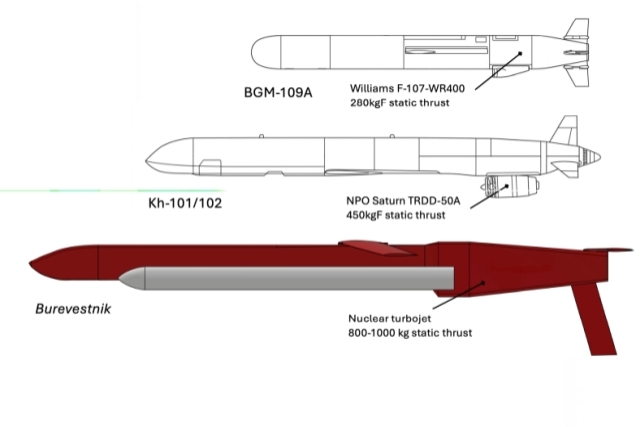
The Russian 9M730 Burevestnik cruise missile uses a direct-cycle nuclear turbojet engine that best explains the claimed ultra-long flight duration and dimensions of the rocket, according to two scientists from the Massachusetts Institute of Technology (MIT).
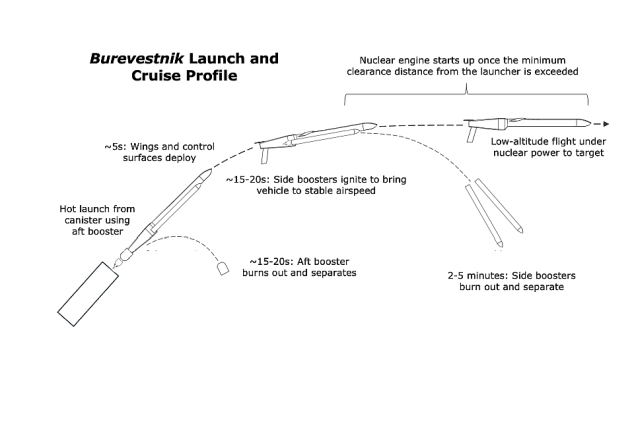
The concept of operation looks like this: first, the rocket starts with the help of a solid-fuel accelerator, which accelerates it and provides the initial flight. Then the main nuclear propulsion engine comes into operation, the scientists-Jake J. Hecla and R. Scott Kemp theorized.
The compressor forces atmospheric air in, the air passes through numerous narrow channels around the nuclear fuel, is heated by the heat of nuclear fission, and, expanding, is forced out through the nozzle back. It is this flow that creates thrust.
The main difference between this scheme and a conventional aircraft engine is that the rocket does not carry a large supply of chemical fuel for the main flight. Its range is limited not by the amount of kerosene or other fuel, but by the resource of the nuclear energy source.
That is why the Russian side speaks of an "almost unlimited" range, while Western assessments associate the "Burevestnik" with ultra-long flights at low altitudes.
Radioactive trial
At the same time, such compactness has a critical disadvantage: if air passes directly through the reactor, it will almost certainly take some of the radioactive products with it and throw them into the rocket's wake. The analysis calls this concept the most likely, but also the dirtiest. A direct cycle almost certainly leaves radioactive material emissions throughout the flight, a research paper published by the scientists said.
Simulations show that escaping neutrons will generate in excess of 5 TBq of gaseous radionuclides per MW-hr of flight, including isotopes such as 41Ar, 85mKr, 83mKr and 14C, some of which may
be detectable using existing monitoring networks.
The researchers also consider a closed indirect scheme, where the reactor does not heat the air directly, but an intermediate coolant, to be unlikely. This option would require larger dimensions, greater mass, and a more complex design, and for a rocket of this class, it seems impractical.
Therefore, it is the direct cycle that explains why the Burevenstnik can remain in the air for a very long time, but at the same time poses a radiation threat along its flight path.
The missile was last tested on October 21, 2025. Then, according to official representatives of the Russian Ministry of Defense, the missile's flight lasted about 15 hours, during which it covered approximately 14 thousand kilometers.
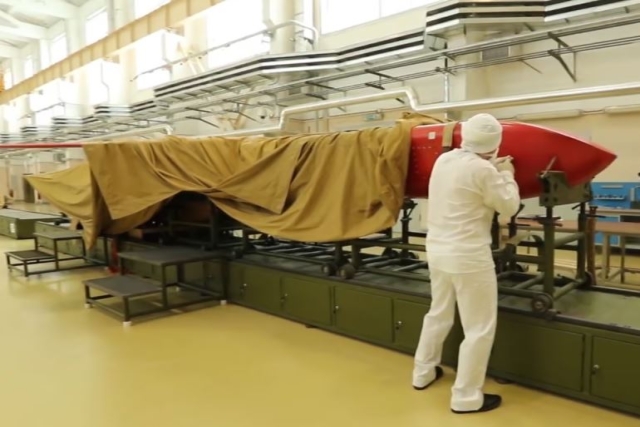
Russia Tests Nuclear-powered Cruise Missile, Burevestnik
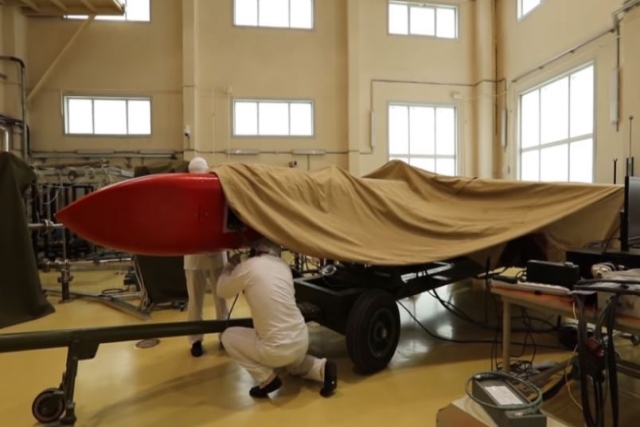
Russia Claims Testing Complete of 'Burevestnik' Nuclear-powered Cruise Missile
Diehl Defence to Acquire Explosive Ordnance Disposal Firm, EST Energetics
Russian Burevestnik Nuclear-powered Cruise Missile Could Release Radioactive Material During Flight
French DGA to Add Collaborative Combat, ISR Mission Capability to A400M Aircraft...
Indian Navy to Commission Stealt Frigate, Anti-submarine Craft, Hydrographic Survey Vessel

One Month Since U.S., Israeli War Against Iran: Who Is Gaining?
One month after the United States and Israel launched coordinated strikes on Iran on February 28 the conflict has expanded...
Modern Tank Showdown: T-90MS, Leopard 2A7, M1E3 Abrams Compared
Main Battle Tanks (MBTs) have shown their mettle in recent conflicts such as in Ukraine despite being increasingly vulnerable to...
European Nations Prioritizing Europe-made IRIS-T & SAMP-T over American Patriot Air Defense Systems?
European nations looking to procure new air defense systems appear to be giving the much-vaunted American Patriot a miss in...
Russian T-90MS Crew Discuss Future Upgrades
Defense Mirror spoke with the crew members of the Russian T-90MS main battle tank, produced by UralVagonZavod

China's Mass-produced J-35A Aircraft Set to Disrupt Global Stealth Fighter Market
China is aiming to disrupt the global stealth fighter market by mass-producing its fifth-generation J-35A at a pace comparable to...

The Future of Combat: Miniaturized Laser Weapons Set to Replace Bullets and Missiles
Lasers may soon replace bullets, and drones could disable enemy UAVs with beams of light instead of missiles