Anduril, HD Hyundai Partner to Develop New Autonomous Surface Vessels
Joint program to support U.S. Navy’s Modular Attack Surface Craft effort with modular, dual-use vessels for commercial and defense missions
Anduril Industries and HD Hyundai Heavy Industries have announced a partnership to design and produce a new class of dual-use Autonomous Surface Vessels intended for commercial and defense use, including a variant aligned with the U.S. Navy’s Modular Attack Surface Craft (MASC) program.
The companies said the effort combines HD Hyundai’s shipbuilding experience with Anduril’s software-defined autonomy and mission systems integration. According to both firms, the program aims to create a family of modular vessels that can be produced at speed, reconfigured for different missions, and scaled for U.S. fleet requirements.
The announcement comes as the United States seeks to expand its surface capabilities amid rising maritime competition. China continues to increase naval production, while Russia challenges access in the Black Sea and Arctic. Industry analysts note that these conditions have accelerated U.S. interest in distributed and autonomous platforms that can operate in contested waters.
The Navy’s MASC program is intended to field unmanned, modular vessels in larger numbers to complement manned ships. According to the companies, traditional surface combatants cannot meet emerging volume and production-rate demands alone. The ASV concept is designed to support intelligence, surveillance, electronic warfare, strike, and other missions through interchangeable payloads.
The vessel features an open-architecture design and a central superstructure that provides 360-degree visibility for sensors. Its autonomy software integrates propulsion, navigation, and payload control into a single networked system. The companies said the ship is being built in steel to align with existing U.S. supply chains and simplify long-term maintenance.
The first prototype is being fabricated in South Korea to validate the design and integrate propulsion and power systems before transition to U.S. production. Anduril has invested in revamping the former Foss Shipyard in Seattle, Washington, which will serve as the company’s initial assembly and testing site for low-rate U.S. production of ASVs, including the MASC variant.
The Pacific Northwest region, with its established maritime infrastructure and workforce, is expected to support scaling efforts. Anduril and HD Hyundai are also working with Hadrian, a manufacturing firm providing precision automation and rapid fabrication of ship components to reduce production timelines.
The ASV program extends Anduril’s maritime portfolio, which includes Ghost Shark—developed with the Royal Australian Navy—and other undersea platforms such as Copperhead, Seabed Sentry, Dive-LD, and Dive-XL. The company stated that shared autonomy software and modular payload integration across these systems will support common manufacturing processes.

Fincantieri Signs Deal with Defcomm to Develop Autonomous Surface Drones
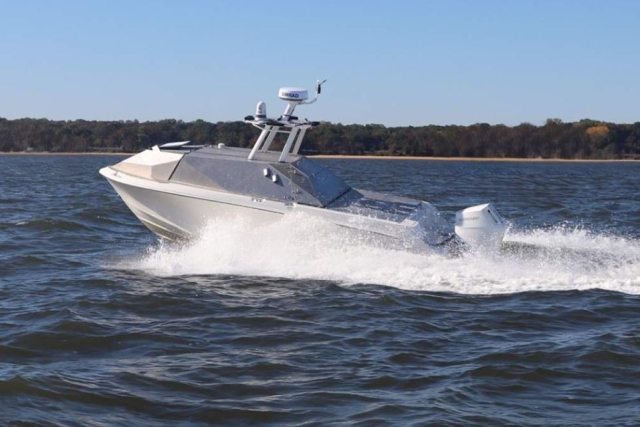
Textron Introduces ‘Tsunami’ Autonomous Surface Vessel
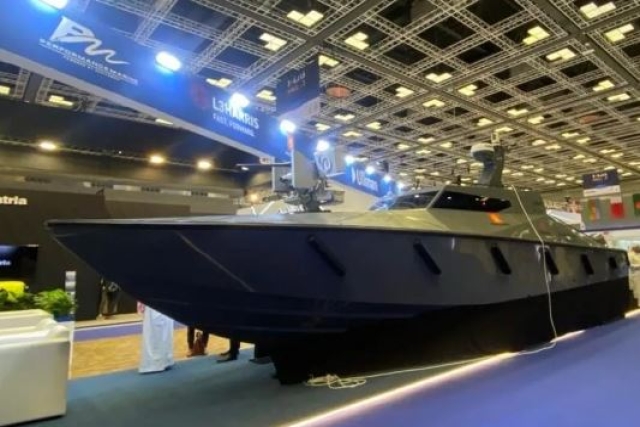
Qatari Firms Unveil Autonomous Surface Vessels at DIMDEX Exhibition
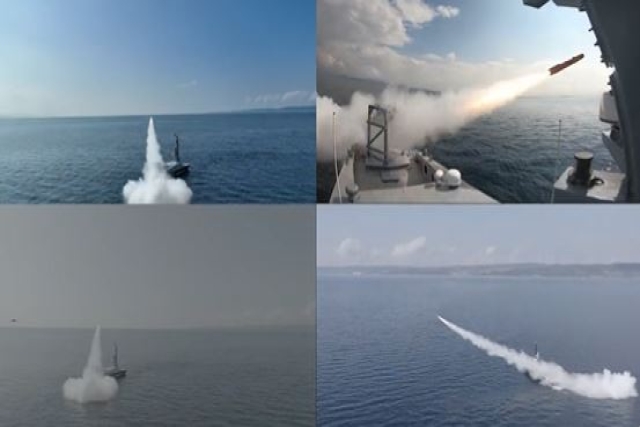
Turkish Unmanned Vessel Fires Cruise Missile; First for an Autonomous Surface Vessel
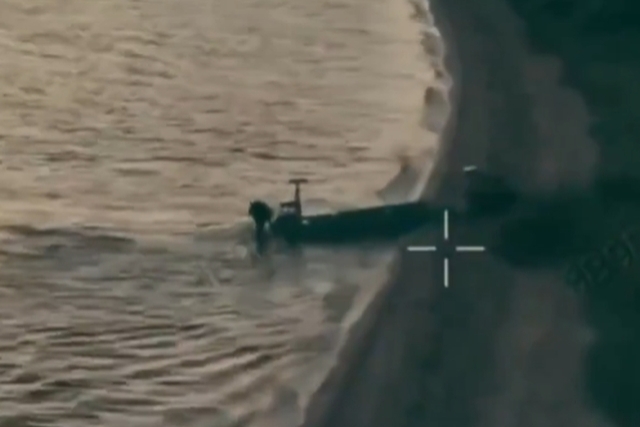
Ukraine Pulls Off World’s First Unmanned Amphibious Assault

IRGC Strikes Two Super Tankers in Strait of Hormuz, 5 Killed in...

Houtis Fire Missiles at Saudi Airport after Riyadh Bombs Yemen’s Sanaa Airport...
Iran Blockade Back, Now U.S. to Charge 20% Hormuz Transit Fee

One Month Since U.S., Israeli War Against Iran: Who Is Gaining?
One month after the United States and Israel launched coordinated strikes on Iran on February 28 the conflict has expanded...
Modern Tank Showdown: T-90MS, Leopard 2A7, M1E3 Abrams Compared
Main Battle Tanks (MBTs) have shown their mettle in recent conflicts such as in Ukraine despite being increasingly vulnerable to...
European Nations Prioritizing Europe-made IRIS-T & SAMP-T over American Patriot Air Defense Systems?
European nations looking to procure new air defense systems appear to be giving the much-vaunted American Patriot a miss in...
Russian T-90MS Crew Discuss Future Upgrades
Defense Mirror spoke with the crew members of the Russian T-90MS main battle tank, produced by UralVagonZavod
China's Mass-produced J-35A Aircraft Set to Disrupt Global Stealth Fighter Market
China is aiming to disrupt the global stealth fighter market by mass-producing its fifth-generation J-35A at a pace comparable to...
The Future of Combat: Miniaturized Laser Weapons Set to Replace Bullets and Missiles
Lasers may soon replace bullets, and drones could disable enemy UAVs with beams of light instead of missiles