Turkish F-16s Shoot Down Unidentified UAV
Drone approaching Ankara from the Black Sea destroyed with air-to-air missile after radar detection
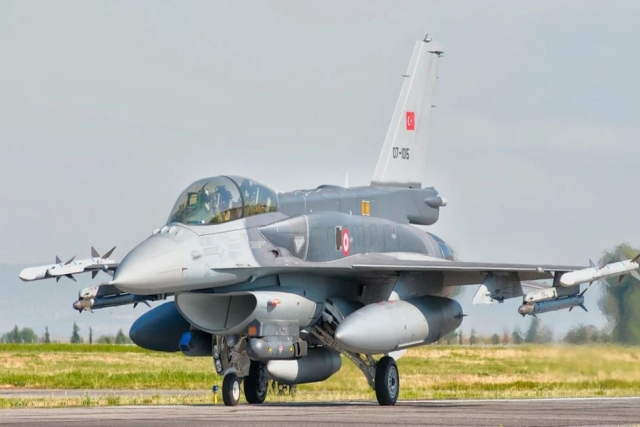
Turkey shot down an unidentified unmanned aerial vehicle (UAV) on Tuesday after it violated Turkish airspace while approaching Ankara from the Black Sea.
The country’s Ministry of National Defense stated that Turkish radars detected the target and tracked it before F-16s destroyed it in a safe area away from populated locations. The UAV was first picked up by a long-range early warning radar operated by the Turkish Air Force Radar Position Command along the Kastamonu line, with tracking data relayed in real time to the Combat Air Force Command’s Air Operations Center in Eskişehir. Radar contact was intermittently lost, suggesting a small radar cross-section and possible weather effects.
As the UAV continued toward Turkish airspace, F-16s on Quick Reaction Alert were scrambled. After visual identification confirmed it was a UAV, one F-16 shot it down near Çankırı using an AIM-9X Sidewinder air-to-air missile. Search operations for the wreckage are continuing between Çankırı and Elmadağ.
The UAV’s origin remains unconfirmed. Defense assessments indicate it was much smaller than NATO-operated systems such as the U.S. Global Hawk or Reaper, which routinely fly in international airspace over the Black Sea. Although a Global Hawk reportedly operated near Crimea the same day before returning to Italy, the downed UAV’s size and radar signature make NATO ownership unlikely.
Attention has turned to smaller fixed-wing kamikaze drones used in the Russia–Ukraine war, including the Shahed-136, which are difficult to detect due to their size and low speed. Both Russia and Ukraine deploy such drones in large numbers, with some variants vulnerable to electronic warfare.
The interception near Ankara raised questions about why ground-based air defenses were not used. Air defense is layered and situation-dependent, and that surface-to-air missiles such as HİSAR-A and HİSAR-O are costly and unsuitable near populated areas against a small UAV, making an F-16 air-to-air missile a safer option.
Officials said the incident highlighted the functioning of Turkey’s Steel Dome air defense framework, with sensors detecting the target and fighter aircraft carrying out the interception. They added that Steel Dome remains an evolving system combining aircraft, sensors, missiles, electronic warfare, and command-and-control assets.
U.K. Okays Turkish Munitions into Eurofighter Jets Bound for Ankara
Netanyahu Quietly Moves to Block U.S. F-35 Sales to Saudi Arabia, Turkey...
No Decision to Transfer, Sell or Dispose off Russian S-400 Air...

U.S. Pressures Turkey Over S-400 in Talks on F-35 Fighter Jet Reentry...
Russia's Unmanned Systems Group Signs Several International Contracts to Sell its Supercam...

50 Killed, 500 Injured in U.S. Airstrikes Against Iranian
US Turns Israel’s Ben Gurion Airport into Forward Base for War...
Greece to Procure Aero Virionment’s Switchblade 300 Miniature Missiles

One Month Since U.S., Israeli War Against Iran: Who Is Gaining?
One month after the United States and Israel launched coordinated strikes on Iran on February 28 the conflict has expanded...
Modern Tank Showdown: T-90MS, Leopard 2A7, M1E3 Abrams Compared
Main Battle Tanks (MBTs) have shown their mettle in recent conflicts such as in Ukraine despite being increasingly vulnerable to...
European Nations Prioritizing Europe-made IRIS-T & SAMP-T over American Patriot Air Defense Systems?
European nations looking to procure new air defense systems appear to be giving the much-vaunted American Patriot a miss in...
Russian T-90MS Crew Discuss Future Upgrades
Defense Mirror spoke with the crew members of the Russian T-90MS main battle tank, produced by UralVagonZavod

China's Mass-produced J-35A Aircraft Set to Disrupt Global Stealth Fighter Market
China is aiming to disrupt the global stealth fighter market by mass-producing its fifth-generation J-35A at a pace comparable to...

The Future of Combat: Miniaturized Laser Weapons Set to Replace Bullets and Missiles
Lasers may soon replace bullets, and drones could disable enemy UAVs with beams of light instead of missiles