USS John F. Kennedy Aircraft Carrier Starts Sea Trials After Decade-long Construction
Delayed Ford-class carrier leaves Newport News for first builder’s trials ahead of 2027 delivery
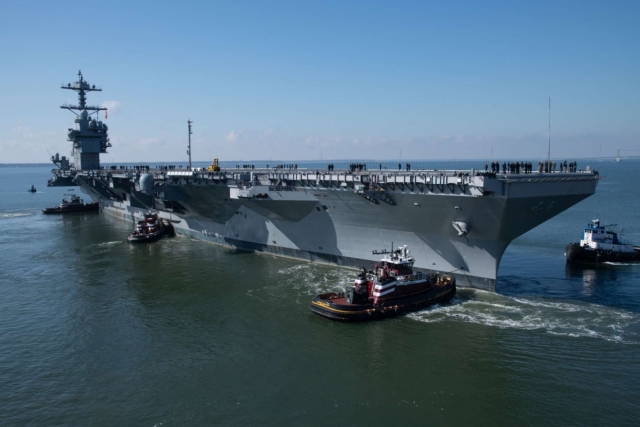
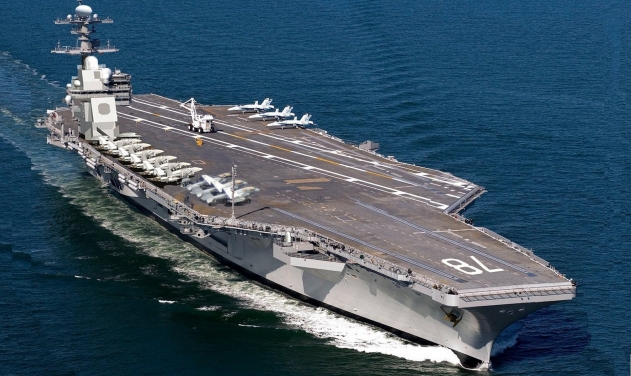
The future USS John F. Kennedy (CVN-79), the U.S. Navy’s second Ford-class aircraft carrier, has put to sea for the first time, beginning builder’s sea trials after more than a decade of construction marked by repeated delays.
The nuclear-powered carrier departed Huntington Ingalls Industries’ (HII) Newport News Shipbuilding yard in Virginia on January 28 starting a trial phase that will test propulsion, power generation, navigation, and other core ship systems under operational conditions.
Laid down in 2015, the roughly 100,000-ton carrier is designed to operate with a reduced crew of about 2,600 sailors and is equipped with electromagnetic aircraft launch systems. The ship has been modified to support F-35C Lightning II fighter jet operations.
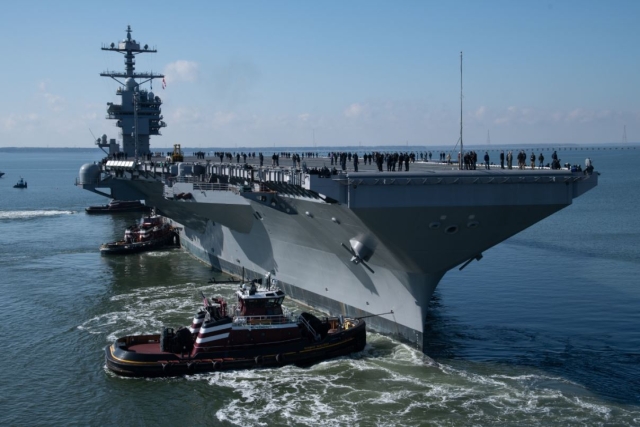
The program has faced repeated delays, with delivery slipping from July 2025 to March 2027, according to U.S. Navy budget documents. The setback is linked to ongoing work to complete and certify the Advanced Arresting Gear and Advanced Weapons Elevators, both new Ford-class systems.
In 2020, the Navy scrapped a two-phase delivery plan in favour of a single-phase approach, adding about two years of design and construction work, according to Fiscal Year 2024 budget documents, and installing the Enterprise Air Surveillance Radar in place of the dual-band radar used on USS Gerald R. Ford.
Images released by the shipbuilder show noticeable differences in John F. Kennedy’s island structure compared with Gerald R. Ford, partly linked to the radar changes. Newport News Shipbuilding’s president said in December that the carrier was expected to reach preliminary acceptance by mid-2026, ahead of its planned delivery in 2027.
GA-ASI Wins Sustainment Contract for Ford-Class Launch and Recovery Systems
Huntington Ingalls to Float USS John F. Kennedy Ford-Class Carrier
Ford-class US Navy Aircraft Carrier Self Defense System undergoes first live test
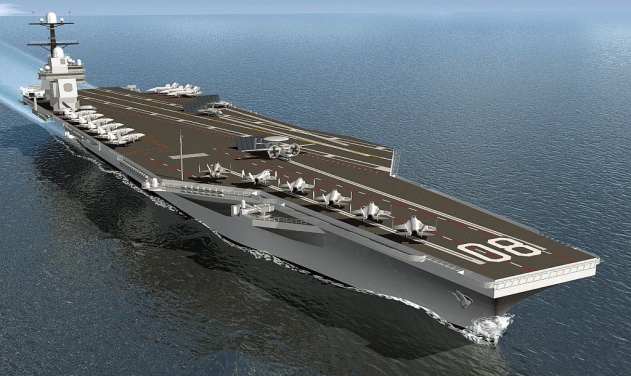
US Navy’s Third Ford-class Nuclear Powered Supercarrier To Get Advanced Arresting Gear...

Anthropic Calls U.S. Order to Suspend Access to Fable 5 and Mythos...
Leonardo Fiies Apache Competitor Aw249 Helicopter at ILA Berlin 2026 Airshow

Iran Insisting on “Dilution” of Uranium Within Its Territory in Potential Agreement...

Ukrainian MoD, Palantir Tech Developing Drone Detection Models Using Russian War Data

One Month Since U.S., Israeli War Against Iran: Who Is Gaining?
One month after the United States and Israel launched coordinated strikes on Iran on February 28 the conflict has expanded...

Modern Tank Showdown: T-90MS, Leopard 2A7, M1E3 Abrams Compared
Main Battle Tanks (MBTs) have shown their mettle in recent conflicts such as in Ukraine despite being increasingly vulnerable to...
European Nations Prioritizing Europe-made IRIS-T & SAMP-T over American Patriot Air Defense Systems?
European nations looking to procure new air defense systems appear to be giving the much-vaunted American Patriot a miss in...

Russian T-90MS Crew Discuss Future Upgrades
Defense Mirror spoke with the crew members of the Russian T-90MS main battle tank, produced by UralVagonZavod

China's Mass-produced J-35A Aircraft Set to Disrupt Global Stealth Fighter Market
China is aiming to disrupt the global stealth fighter market by mass-producing its fifth-generation J-35A at a pace comparable to...

The Future of Combat: Miniaturized Laser Weapons Set to Replace Bullets and Missiles
Lasers may soon replace bullets, and drones could disable enemy UAVs with beams of light instead of missiles