Poland Moves to Seal Eastern Airspace with New Counter-Drone Shield
18 battery modules ordered after Russian UAV incursions over NATO territory in Sept 2025

Poland has signed contracts for a new counter-drone air defence system as Warsaw moves to close gaps exposed by unmanned aerial vehicle incursions along NATO’s eastern edge.
The agreements were signed on January 30 at PIT-Radwar SA’s facility in Kobyłka between the State Treasury–Armaments Agency and a consortium led by Polska Grupa Zbrojeniowa, with Kongsberg Defence & Aerospace and Polish firm Advanced Protection Systems involved in delivery. The deal covers 18 battery modules for anti-aircraft systems designed specifically to detect and engage unmanned aerial vehicles.
Deputy Prime Minister and Defence Minister Władysław Kosiniak-Kamysz said the SAN program represents a full defensive architecture rather than a single weapon. “It is an entire system of interconnected systems: effectors, sensors, and mechanisms for dealing with airborne threats – including airborne threats, helicopter threats, and, above all, threats from unmanned aerial vehicles,” he said during the signing ceremony.
Kongsberg announced Poland’s anti-drone contract was worth $1.67 billion, but provided no other details regarding how many units were sold.
According to the Ministry of National Defence, the contract includes 18 anti-drone batteries, 52 fire platoons, 18 command platoons, and 703 vehicles. About 400 vehicles will be built on Jelcz chassis, with roughly 300 based on the Igwan platform. Each battery module will comprise three firing platoons and a support platoon, while every firing platoon will be able to independently detect, track, identify, and engage aerial targets.
Kosiniak-Kamysz pointed to a specific moment that accelerated the program. “The night of September 9–10, 2025, when our airspace was violated, when Russian unmanned aerial vehicles first appeared over NATO territory, was a turning point,” he said.
He added that the SAN system required months of integration work to merge sensors, command elements, and effectors into a single operational network involving Polish and Norwegian industry.
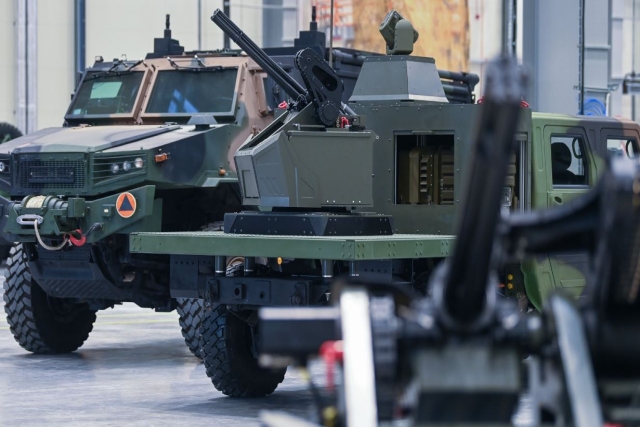
Prime Minister Donald Tusk said the program reflects Poland’s frontline role in European security. “Poland bears the responsibility, expenses, and organization of protecting the Polish, European, and NATO borders, but we cannot and will not be left alone,” he said, confirming the use of European Union funding, including resources from the SAFE mechanism.
The SAN systems will be integrated into Poland’s wider, multi-layered air and missile defence framework, using kinetic and non-kinetic measures to counter unmanned aerial threats. Deployment will focus primarily on eastern Poland, which borders Belarus, Ukraine, and Russia’s Kaliningrad region.
The contract was signed on behalf of the Armaments Agency by Brigadier General Michał Marciniak, the defence ministry’s plenipotentiary for the integrated air and missile defence system.

Poland Inks $1.67B Counter-Drone Deal with Kongsberg
Turkey to Sell Russian S-400 Systems to Third Country as GE Engine...
Pentagon Awards Contracts to Develop Laser Weapons Against Cruise Missiles, Drones

Iran Threatens to Close Strait of Hormuz as US Signals Return to...
China-made Aircraft Fly in U.S. Airshow for First Time

One Month Since U.S., Israeli War Against Iran: Who Is Gaining?
One month after the United States and Israel launched coordinated strikes on Iran on February 28 the conflict has expanded...
Modern Tank Showdown: T-90MS, Leopard 2A7, M1E3 Abrams Compared
Main Battle Tanks (MBTs) have shown their mettle in recent conflicts such as in Ukraine despite being increasingly vulnerable to...
European Nations Prioritizing Europe-made IRIS-T & SAMP-T over American Patriot Air Defense Systems?
European nations looking to procure new air defense systems appear to be giving the much-vaunted American Patriot a miss in...
Russian T-90MS Crew Discuss Future Upgrades
Defense Mirror spoke with the crew members of the Russian T-90MS main battle tank, produced by UralVagonZavod

China's Mass-produced J-35A Aircraft Set to Disrupt Global Stealth Fighter Market
China is aiming to disrupt the global stealth fighter market by mass-producing its fifth-generation J-35A at a pace comparable to...

The Future of Combat: Miniaturized Laser Weapons Set to Replace Bullets and Missiles
Lasers may soon replace bullets, and drones could disable enemy UAVs with beams of light instead of missiles