Iran Used Shahed-136 Loitering Munitions to Attack U.S. Bases in Gulf Countries
Shahed-type drone debris recovered in U.A.E. as regional air defenses intercept multiple aerial threats
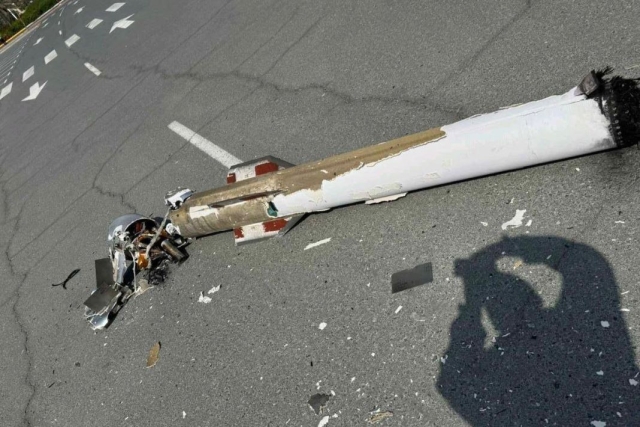
Iran appears to have used Shahed-136 loitering munitions to attack U.S. bases across several Gulf countries following joint Israel-U.S. airstrikes on Iranian territory.
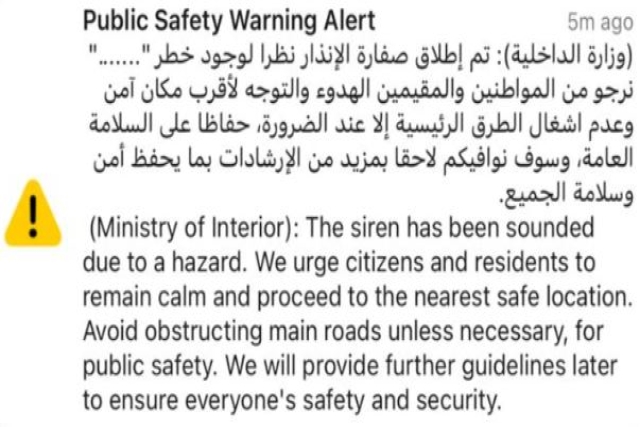
The U.A.E. Ministry of Defence shared images showing debris from intercepted Iranian weapons, stating that air defense systems destroyed a new wave of Iranian missiles launched towards the country, adding that the operation was conducted without damage or injuries. Debris reportedly fell in parts of Abu Dhabi, including Saadiyat Island, Khalifa City, Baniyas Area, Mohammed Bin Zayed area and Al Falah area.
Dubai's Burj Khalifa has reportedly been evacuated due to fear of war spreading.
Based strictly on visible physical characteristics, the recovered wreckage does not resemble a ballistic missile. The debris shows a lightweight composite cylindrical fuselage with white skin, small delta-style control surfaces, exposed internal wiring and a compact nose-mounted explosive assembly. There is no evidence of a large-diameter solid rocket motor casing, reentry vehicle section or thermal shielding typically associated with ballistic missiles.
The configuration matches documented wreckage of the Shahed-136, a one-way attack UAV, also known as Geran-2 in Russian service. The Shahed-136 is reported to have a range of approximately 2,000–2,500 km and carries a 30–50 kg high-explosive warhead. It uses GPS and inertial navigation and is typically launched from a truck-mounted rack system.
Tehran Times reported that Iranian Shahed-136 drones struck the U.S. naval base in Bahrain, claiming a direct hit on a radar dome at the headquarters of the U.S. Navy Fifth Fleet in Al-Juffair. A widely circulated video on social media appears to show an impact consistent with a loitering munition strike.

The General Command of the Kuwait Armed Forces stated that air defense systems engaged aerial missiles detected in Kuwaiti airspace in accordance with operational procedures. Iranian attacks have also been reported in Jordan, Qatar, Saudi Arabia and Kuwait.
Minutes earlier, Tehran Times reported a new wave of missile attacks targeting Israel.
Weapons being used by the U.S., Israel and Iran
In addition to the Shahed-136, Iran may have employed ballistic missile systems including the Shahab-3, Emad and Ghadr.
Meanwhile, reports indicate that Israel and the U.S. conducted strikes against Iran using cruise missiles, fighter aircraft, guided bombs and unmanned systems. The Tomahawk cruise missile, launched from U.S. Navy ships and submarines, is capable of striking targets at distances exceeding 1,600 km depending on the variant. Israel operates the F-35I Adir and the F-15I Ra'am for long-range strike missions. Israeli stand-off weapons include Delilah and Rampage missiles, while precision-guided munitions include SPICE kits developed by Rafael Advanced Defence Systems, the Joint Direct Attack Munition and the GBU-28 penetrator bomb. Israel also deploys unmanned systems such as the IAI Heron and the IAI Eitan.
Air Defense Systems deployed in the affected Gulf countries
Air defense networks across Kuwait, Bahrain, Qatar, Saudi Arabia, the U.A.E. and Jordan operate multi-layered systems designed to counter ballistic missiles, cruise missiles and drones.
All six countries field Patriot PAC-3 systems, while Saudi Arabia and the U.A.E. operate Terminal High Altitude Area Defense (THAAD) systems. Qatar operates NASAMS III and the U.A.E. also fields Cheongung II and Barak systems. Jordan relies on I-Hawk and Stinger missiles and periodically hosts U.S. Patriot batteries during heightened tensions.
The U.S. military is said to have deployed additional Patriot and THAAD batteries to approximately 20 bases across the region, including Prince Sultan Air Base in Saudi Arabia, Al Udeid Air Base in Qatar, Al-Dhafra Air Base in the U.A.E., Ali Al Salem Air Base in Kuwait and the U.S. Navy’s Fifth Fleet Headquarters in Bahrain. In early 2026, several units shifted from static to mobile configurations to reduce vulnerability to retaliatory strikes.

U.S. Bases Unscathed As Most Iranian Missiles Intercepted in 6 Mid-East Nations

Explosion in Abu Dhabi; U.A.E. says Intercepted Iranian Missiles
U.S. Naval Base in Bahrain under Attack from Iran, 20-Storey Building Damaged...

U.S., Israel Launch "Major Combat Operations" in Iran, Trump Confirms
70 Civilians killed, 360 Injured in Ukrainian Strikes on Russian Economic Targets

Hand to Hand Combat Between Chinese, Philippine Soldiers in South China Sea

2 US troops KILLED, 1 Missing, 4 Injured in Iran Missile Strikes
Russia's Unmanned Systems Group Signs Several International Contracts to Sell its Supercam...

One Month Since U.S., Israeli War Against Iran: Who Is Gaining?
One month after the United States and Israel launched coordinated strikes on Iran on February 28 the conflict has expanded...
Modern Tank Showdown: T-90MS, Leopard 2A7, M1E3 Abrams Compared
Main Battle Tanks (MBTs) have shown their mettle in recent conflicts such as in Ukraine despite being increasingly vulnerable to...
European Nations Prioritizing Europe-made IRIS-T & SAMP-T over American Patriot Air Defense Systems?
European nations looking to procure new air defense systems appear to be giving the much-vaunted American Patriot a miss in...
Russian T-90MS Crew Discuss Future Upgrades
Defense Mirror spoke with the crew members of the Russian T-90MS main battle tank, produced by UralVagonZavod

China's Mass-produced J-35A Aircraft Set to Disrupt Global Stealth Fighter Market
China is aiming to disrupt the global stealth fighter market by mass-producing its fifth-generation J-35A at a pace comparable to...

The Future of Combat: Miniaturized Laser Weapons Set to Replace Bullets and Missiles
Lasers may soon replace bullets, and drones could disable enemy UAVs with beams of light instead of missiles