Iranian Fighter Jet, ‘Kowsar,’ Not Decades-old American F-5 Bombed U.S. Base in Kuwait
The Kowsar is a deep upgrade of the F-5 bringing it up to 4th generation standards and mass-produced in Iran

The fighter jet that bombed the U.S. base in Kuwait was not a 50-year old Northrop F-5 but its modern clone called ‘Kowsar,’ equipped with 4th generation equivalent radar, avionics and fire control systems.
According to a report in Iranian news agency, PressTV, the Kowsar successfully evaded layered American and Kuwaiti air defense systems to strike the highly fortified US military base in Kuwait on in the first week of March, around time when U.S. and Israel were engaged in a massive air assault on Iran.
An Iranian fighter jet – an advanced derivative of the Northrop F-5 platform – took off from a base in Iran, likely from southern Khuzestan province. It then flew at extremely low altitude across the Persian Gulf toward Kuwait.
The aircraft, carrying a payload of bombs, penetrated the air defense network protecting Camp Buehring, a major American military installation located just a short distance from the Iraqi border.
The pilot released the ordnance successfully. The bombs struck the base destroying several aircraft, radars and fortified bunkers with 500 pound bombs, PressTV said quoting Islamic Revolutionary Guard Corps (IRGC) sources.
Later confirmed by US officials speaking to US media, it represented the first time a fixed-wing aircraft had bombed a major American military base since the Korean War. The damage to the base was not highlighted in subsequent U.S. media briefings.
“The Kowsar attack demonstrated that Iran’s air force – long written off by Western analysts as a relic – remains a potent force,” the report said.
The Iranian strike on Camp Buehring was not a matter of luck or coincidence but the result of meticulous planning, technical skill, and an intimate understanding of American air defense vulnerabilities, according to Iranian military experts.
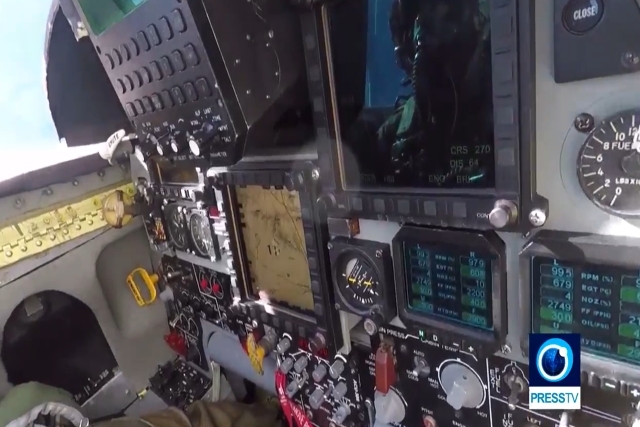
The Iranian pilot flew the jet at an altitude of only a few dozen meters above the terrain or water surface, the aircraft remained below the radar horizon of Patriot missile batteries and other ground-based interception systems.
These systems, designed to detect and track targets at higher altitudes, could not lock onto an aircraft flying so low, as the curvature of the earth and ground clutter masked its approach.
The distance from southwestern Iran to Kuwait is relatively short, making the mission feasible for the fighter jet’s range without requiring external fuel tanks.
The aircraft likely carried a payload of unguided bombs, estimated at between 250 and 500 kilograms each, with a total ordnance load of approximately 3,000 kilograms.
The Iranian pilot knew that American AWACS aircraft would detect his takeoff, even at low altitude, but he was confident that no US F-15s were patrolling in that specific sector at that moment.
More sophisticated still, the attack pattern was designed to complement Iranian drone operations.
The fighter’s approach was masked by Iranian drones and missiles that were flying towards several U.S. targets scattered all across the Gulf region that consumed U.S. and Gulf surveillance resources. The Shahed-136 one-way attack drones could fly at low altitudes, potentially appearing on radar screens as additional aircraft and probably confused the Americans about the true nature of the threat.

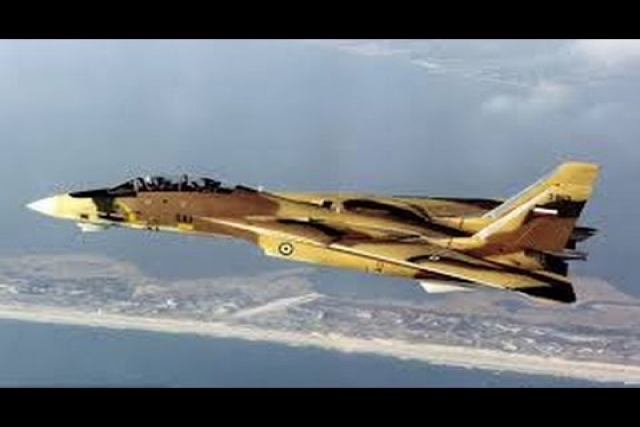
Iran Air Force Receives Locally-Overhauled Western Fighters, Cargo Planes
Iran Inaugurates Production Line of Kowsar Fighter Jets

US Warships Forced to Retreat after Iranian Navy Fires Warning Shots in...

Ukraine Struck 18 Russian Oil Facilities in May, the Farthermost being 1700...
After Australia, Korea Next in Line to Acquire Nuclear-powered Submarines

Missed Patriot Interceptor, Not Iranian Drone Hit Kuwait Airport

One Month Since U.S., Israeli War Against Iran: Who Is Gaining?
One month after the United States and Israel launched coordinated strikes on Iran on February 28 the conflict has expanded...
Modern Tank Showdown: T-90MS, Leopard 2A7, M1E3 Abrams Compared
Main Battle Tanks (MBTs) have shown their mettle in recent conflicts such as in Ukraine despite being increasingly vulnerable to...
European Nations Prioritizing Europe-made IRIS-T & SAMP-T over American Patriot Air Defense Systems?
European nations looking to procure new air defense systems appear to be giving the much-vaunted American Patriot a miss in...

Russian T-90MS Crew Discuss Future Upgrades
Defense Mirror spoke with the crew members of the Russian T-90MS main battle tank, produced by UralVagonZavod

China's Mass-produced J-35A Aircraft Set to Disrupt Global Stealth Fighter Market
China is aiming to disrupt the global stealth fighter market by mass-producing its fifth-generation J-35A at a pace comparable to...

The Future of Combat: Miniaturized Laser Weapons Set to Replace Bullets and Missiles
Lasers may soon replace bullets, and drones could disable enemy UAVs with beams of light instead of missiles