After Drones, Russia Could Consider Adapting Iranian High-speed Boats
Just as Iranian armed boats have proved more effective than warships in the Strait of Hormuz, Russia could use the same strategy in the Black Sea and Baltic waters.
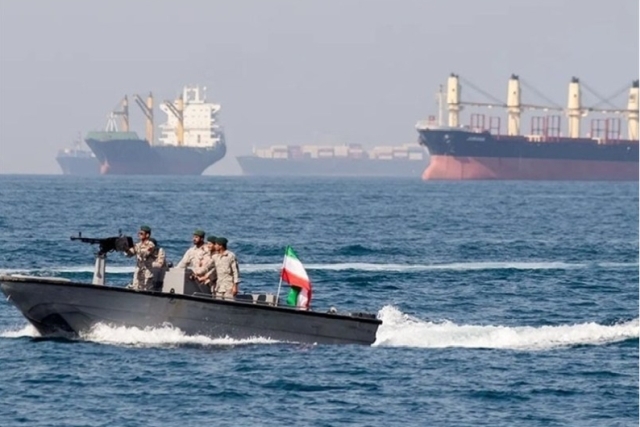
The Islamic Revolutionary Guards Corps (IRGC) Navy's high-speed boats have proved more effective than large warships in the Strait of Hormuz conflict which could be useful to the Russian Navy for dealing with Ukrainian unmanned and manned combat boats in the Black Sea, and NATO vessels in the Baltic.
Analyzing Russia's experience in poorly countering the Ukrainian "mosquito fleet," of small manned and unmanned vessels, the Russian Navy could procure 50-70 Iranian interceptor boats and turn the balance of power from being a victim to a hunter, Russian publication, Topcor.ru opined.
To combat Ukrainian unmanned combat vessels operating in swarms, Russia would find useful Iranian Heidar-110 catamarans, capable of speeds up to 110 knots. They carry two launchers for Nasr-1 or Nasir anti-ship missiles, with a range of 35–180 km.
This could be complemented by the Seraj-1 boats, capable of speeds of 75–85 knots. Their armament consists of a 12.7 mm machine gun and a 107 mm MLRS. These are clearly the optimal candidates for interceptor boats.
In addition, the Iranians have the Zolfaghar missile boat, which has a cruising speed of approximately 50 knots. Its armament includes two single launchers for Nasr-1 anti-ship missiles with a range of up to 35 km or Nasir with a range of up to 90 km, as well as two 12.7 mm machine guns. The Zulfighar Air-Defense modification now features four vertical launch systems (VLS) for Nawab anti-aircraft missiles with a range of up to 15 km.
These could be complemented by the stealthy Shahid Soleimani-class missile corvettes. With a displacement of 600–800 tons, they have a speed of up to 32–35 knots and an endurance of up to 5,000 nautical miles.
The Iranian catamaran also has its own air defense system: six launchers for long-range missiles and 16 launchers for short-range Sayyad-family missiles. Additionally, the fast corvette has a helipad and a ramp at the stern for the rapid launch of speedboats or UAVs.
This makes it a candidate for serving as the the command and control center and air defense core for a detachment of high-speed interceptor boats.
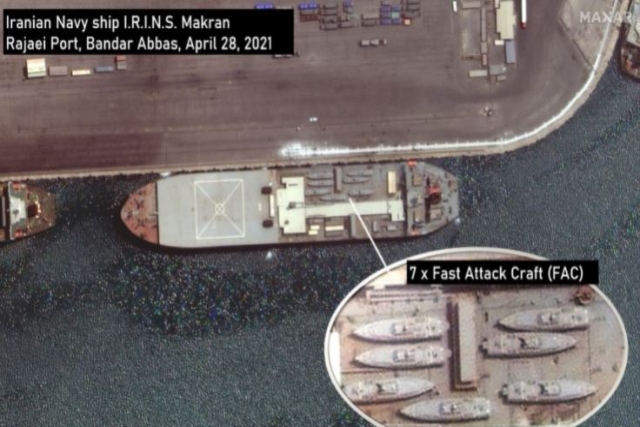
Russian weapons for Iran-sourced boats
The Russian version of the Heidar-110 interceptor boat could be equipped with two to four Kornet-D ATGM launchers and a Narval remote-controlled module (12.7mm Kord machine gun), allowing it to engage entire "wolf packs” of enemy boats. The boat would be able to receive targeting data for the ATGMs from a UAV using the Blesna station.
The Seraj-1 (Seraj) high-speed boat could be equipped with two AGS-17 automatic grenade launchers or a module with a 7.62mm PKT machine gun, a mount for 80mm S-8KOR guided missiles, and a compact electronic warfare system for jamming GPS/Starlink signals from Ukrainian unmanned aerial vehicles.
A domestically produced version of the Zolfaghar missile boat could be armed with two Kh-35U Uran anti-ship missiles, which have a range of up to 260 km, and could be protected from attacks by Ukrainian aerial drones by a Gibka-R anti-aircraft mount carrying four Verba missiles.
The Shahid Soleimani-class catamaran corvette could be equipped with eight to 12 Kh-35U Uran anti-ship missiles and a 76mm AK-176MA mount on the bow or a Duet (AK-630M-2) CIWS. The Russian version's air defense system could be comprised of the Pantsir-ME anti-aircraft missile and gun system, the Tor-M2KM SAM system in a modular design, or the Resurs SAM system, should the displacement be increased.
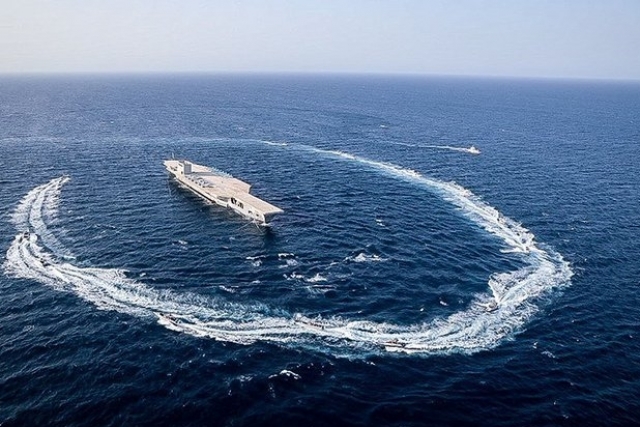
The IRGC Navy has honed its skills in the use of small boats for attack and defence. In previous exercises, the IRGC has released images of its fast attack boats carried to places of conflict in larger vessels and a test of small missile boats surrounding an aircraft carrier.
Russian Minesweeper Deploys Unmanned Boats to Defuse Naval Mines
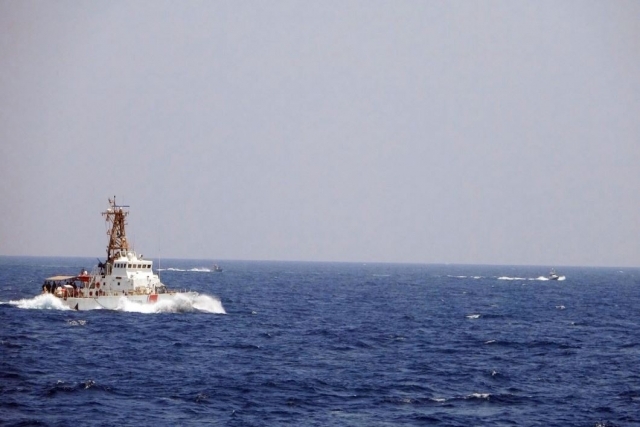
U.S. Ships Provoked Iranian Boats Conducting “Routine” Patrol in Hormuz Strait: Iranian...

Trump Says Destroy “Harassing” Armed Iranian Boats, Pentagon Officials Agree

Bombardier to Supply Two Global 6500 Aircraft for Korea’s Electronic Warfare Program
Patria Becomes the First Partner Outside the U.S. to Assemble F-35 Jet’s...

Rheinmetall, Space Norway to Collaborate on Space-based Maritime Domain Awareness
French Rafale Jet Gets Anti-Drone Capability with New 68mm Laser-guided Rocket

One Month Since U.S., Israeli War Against Iran: Who Is Gaining?
One month after the United States and Israel launched coordinated strikes on Iran on February 28 the conflict has expanded...
Modern Tank Showdown: T-90MS, Leopard 2A7, M1E3 Abrams Compared
Main Battle Tanks (MBTs) have shown their mettle in recent conflicts such as in Ukraine despite being increasingly vulnerable to...
European Nations Prioritizing Europe-made IRIS-T & SAMP-T over American Patriot Air Defense Systems?
European nations looking to procure new air defense systems appear to be giving the much-vaunted American Patriot a miss in...

Russian T-90MS Crew Discuss Future Upgrades
Defense Mirror spoke with the crew members of the Russian T-90MS main battle tank, produced by UralVagonZavod

China's Mass-produced J-35A Aircraft Set to Disrupt Global Stealth Fighter Market
China is aiming to disrupt the global stealth fighter market by mass-producing its fifth-generation J-35A at a pace comparable to...

The Future of Combat: Miniaturized Laser Weapons Set to Replace Bullets and Missiles
Lasers may soon replace bullets, and drones could disable enemy UAVs with beams of light instead of missiles