Rafale Jet Combines with Electronic Warfare Payload-Carrying UAV to Strike Simulated Target
Mounted on drones, the EW payload called NAMIB precisely locates sources of electromagnetic emissions
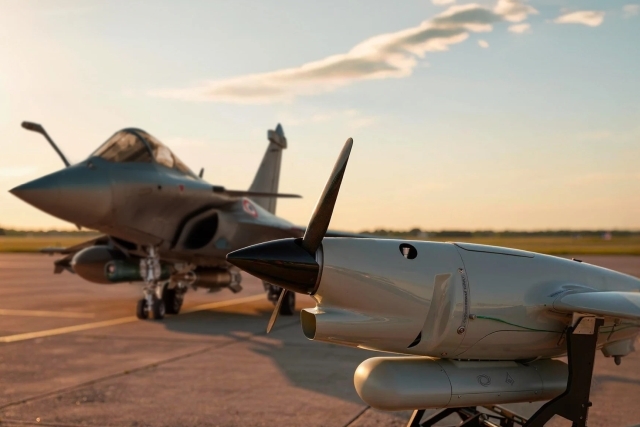
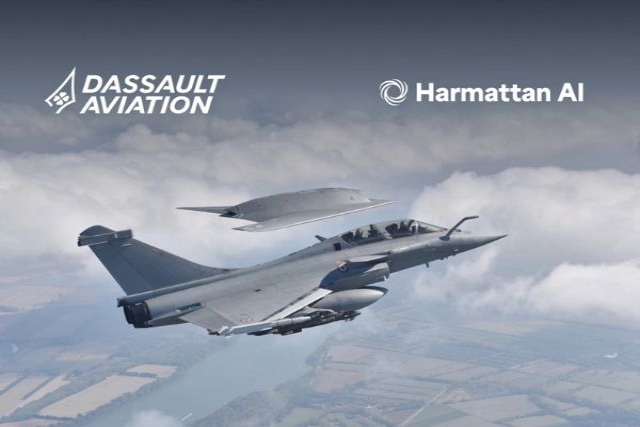
Dassault Aviation and Harmattan AI successfully executed a collaborative in-flight engagement between a Rafale F4 and an unmanned aerial system equipped with the NAMIB payload, a new electronic warfare device jointly developed by both companies.
NAMIB is an electronic warfare payload capable of detecting, identifying, and geo-locating electromagnetic emissions, in particular those from air defense systems. It can be carried by tactical drones as well as by longer-endurance, fixed-winged unmanned aircraft.
During the flight, NAMIB discreetly detected and precisely geo-located a radar located several dozen kilometers away. The target’s location was transmitted to the Rafale, which then simulated a strike on the target.
The development of NAMIB, initiated in January 2026, is one of the key initiatives under the strategic partnership between Dassault Aviation and Harmattan AI, which aims to integrate advanced autonomous capabilities into the next generation of air combat systems.
“This flight demonstrates the Rafale’s real and tangible multi-domain collaborative combat capabilities. The F4 standard architecture enables seamless communication with a very broad range of operational assets, including ground forces, allowing it to effectively leverage new capabilities, such as NAMIB’s electromagnetic detection and geo-location functions”, said Eric Trappier, Chairman and CEO of Dassault Aviation.
“Electronic warfare has become a decisive factor in achieving operational superiority. Through NAMIB, we are demonstrating that these capabilities can now be deployed on lightweight autonomous systems operating close to the threat. This achievement highlights the complementary strengths of Dassault Aviation and Harmattan AI, combining decades of experience in air combat systems with our expertise in autonomy and embedded intelligence,” said Mouad M’Ghari, Co-Founder and CEO of Harmattan AI.
French DGA Orders 5000 Combat Surveillance Drones from Harmattan AI

Russia’s Rostec Tests Filters that Protect Drone Components from Electronic Warfare

L3Harris, Shield AI Demo Autonomous Electronic Warfare Capability
Dassault Aviation Partners with Harmattan AI in $200m Funding Round
US Armed Forces Members to Undergo Testing for Testosterone Levels
Rafale Jet Combines with Electronic Warfare Payload-Carrying UAV to Strike Simulated Target
Iran War Impact: Saudi Arabia to Buy Advanced Precision Kill Weapon II...
Anduril Bags U.S. DoW Contract to Supply Barraduda-500 Stand-off Weapons

One Month Since U.S., Israeli War Against Iran: Who Is Gaining?
One month after the United States and Israel launched coordinated strikes on Iran on February 28 the conflict has expanded...
Modern Tank Showdown: T-90MS, Leopard 2A7, M1E3 Abrams Compared
Main Battle Tanks (MBTs) have shown their mettle in recent conflicts such as in Ukraine despite being increasingly vulnerable to...
European Nations Prioritizing Europe-made IRIS-T & SAMP-T over American Patriot Air Defense Systems?
European nations looking to procure new air defense systems appear to be giving the much-vaunted American Patriot a miss in...
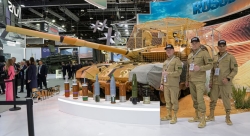
Russian T-90MS Crew Discuss Future Upgrades
Defense Mirror spoke with the crew members of the Russian T-90MS main battle tank, produced by UralVagonZavod

China's Mass-produced J-35A Aircraft Set to Disrupt Global Stealth Fighter Market
China is aiming to disrupt the global stealth fighter market by mass-producing its fifth-generation J-35A at a pace comparable to...

The Future of Combat: Miniaturized Laser Weapons Set to Replace Bullets and Missiles
Lasers may soon replace bullets, and drones could disable enemy UAVs with beams of light instead of missiles