China’s CH-7 High-Altitude Stealth UAV Marks First Flight
The CH-7 is intended for long-endurance intelligence, surveillance, reconnaissance, maritime patrol, and target guidance missions
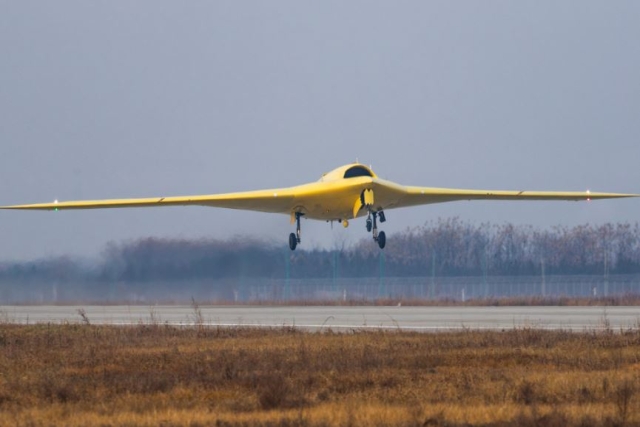
China’s CH-7 high-altitude, high-speed unmanned aerial vehicle (UAV) has completed its first flight at an airfield in northwest China, moving the stealth flying-wing drone into the flight testing phase.
The maiden flight confirms progress on the large tailless aircraft. China Aerospace Science and Technology Corp (CASC) said the initial sortie focused on validating basic design assumptions and key technologies rather than full mission capability, reports semi-official Global Times.
Li Jianhua of CASC said the main objective of carrying out the first flight was to verify the rationality of the CH-7’s design scheme and assess progress in core technological areas.
Li noted that the CH-7 presents higher testing challenges than many other drones. Its high-aspect-ratio, tailless flying-wing configuration increases system complexity and creates inherent directional stability issues, raising both technical difficulty and flight risk during early testing.
During the maiden flight, the CH-7 validated core flight functions, including autonomous taxiing, takeoff and landing, attitude control, and trajectory tracking. According to Li, test results aligned with design expectations and simulation outcomes. CASC said further tests will cover flight performance and payload function verification.
The CH-7 is designed to carry multiple mission payloads, including visible light and infrared sensors, and is intended for long-endurance operations at high altitude. Its roles include ground and maritime observation and data support under complex operational conditions.
A full-scale CH-7 airframe was displayed publicly for the first time at Airshow China 2024 in Zhuhai. Observations at the event showed a top-mounted air intake and a semi-concealed engine exhaust, along with a streamlined external shape. Information released at the airshow stated that the flying-wing configuration supports reduced observability through shaping, radar wave-absorbing treatments, surface coatings, and stealth measures applied to panels, bays, and fasteners.
Demonstration animations shown at the airshow depicted the CH-7 conducting long-duration maritime patrols, detecting targets, and transmitting data to rear command elements. According to the presentation, the drone can provide mid-course or terminal guidance for long-range strike weapons via data links.
The CH-7 is intended battlefield surveillance, intelligence reconnaissance, and air and maritime monitoring, with onboard radar capable of detecting large surface vessels. Its aerodynamic design suggests lower speed than modern fighter jets, making it unsuitable as a close-combat wingman. Instead, it is expected to deploy ahead of other forces for prolonged reconnaissance and surveillance, relaying targeting data to aircraft, missiles, or ground-based strike systems while operating in heavily defended airspace.
China’s Unmanned Airborne Drone Carrier, Jetank Completes Maiden Flight

U.S. Authorities Shut Down China-Linked AI Tech Smuggling Network
China Presents 40-hour Endurance Anti-submarine Drone at Dubai Airshow
China’s ‘Fujian’ Aircraft Carrier Conducts First Maritime Live-force Training

70 Civilians killed, 360 Injured in Ukrainian Strikes on Russian Economic Targets

Hand to Hand Combat Between Chinese, Philippine Soldiers in South China Sea

2 US troops KILLED, 1 Missing, 4 Injured in Iran Missile Strikes
Russia's Unmanned Systems Group Signs Several International Contracts to Sell its Supercam...

One Month Since U.S., Israeli War Against Iran: Who Is Gaining?
One month after the United States and Israel launched coordinated strikes on Iran on February 28 the conflict has expanded...
Modern Tank Showdown: T-90MS, Leopard 2A7, M1E3 Abrams Compared
Main Battle Tanks (MBTs) have shown their mettle in recent conflicts such as in Ukraine despite being increasingly vulnerable to...
European Nations Prioritizing Europe-made IRIS-T & SAMP-T over American Patriot Air Defense Systems?
European nations looking to procure new air defense systems appear to be giving the much-vaunted American Patriot a miss in...
Russian T-90MS Crew Discuss Future Upgrades
Defense Mirror spoke with the crew members of the Russian T-90MS main battle tank, produced by UralVagonZavod

China's Mass-produced J-35A Aircraft Set to Disrupt Global Stealth Fighter Market
China is aiming to disrupt the global stealth fighter market by mass-producing its fifth-generation J-35A at a pace comparable to...

The Future of Combat: Miniaturized Laser Weapons Set to Replace Bullets and Missiles
Lasers may soon replace bullets, and drones could disable enemy UAVs with beams of light instead of missiles