Chinese Research Ship Providing Intelligence on U.S. Fleet to Iran?
Reports say Chinese vessel operating near Sea of Oman may be tracking U.S. naval movements amid rising tensions over Iran

Mounting hostility between the United States and Iran have coincided with reports that a Chinese research vessel is operating near the Sea of Oman, potentially monitoring American naval deployments and sharing maritime intelligence with Tehran.
Unconfirmed reports claim that the Chinese scientific radar ship Ocean No.1 has been sighted in waters near the Sea of Oman, operating under the protection of Type 055 and Type 052 destroyers. Western defense analysts suggest the ship could be tracking the movements of U.S. naval assets, including the USS Abraham Lincoln carrier strike group.
Expanded U.S. naval presence in the Middle East
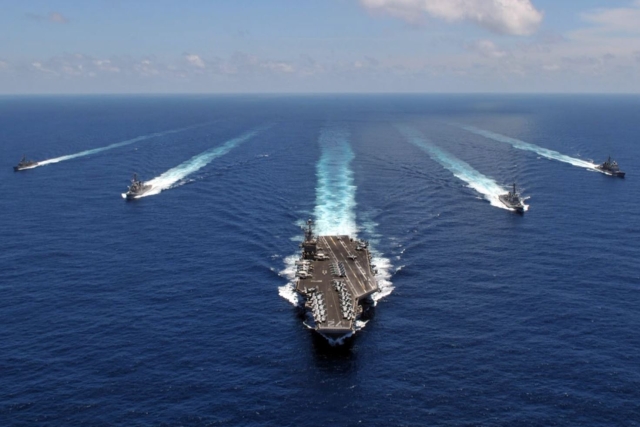
The USS Abraham Lincoln was deployed to the volatile Middle East in January, raising the number of missile destroyers in the region to six. President Donald Trump has also indicated he is considering sending a second aircraft carrier.
Last week, a dozen F-15 fighters, an MQ-9 Reaper drone, and several A-10C Thunderbolt II aircraft arrived at Jordan’s Muwaffaq Salti Air Base, BBC has reported. Satellite imagery reviewed by the publication showed the guided-missile destroyer USS Delbert D Black transiting the Suez Canal toward the Red Sea, while a U.S. Navy MQ-4C Triton drone operated over the Gulf. An E-11A communications aircraft, Boeing P-8 Poseidon reconnaissance aircraft, and E-3G Sentry surveillance planes were also allegedly spotted in the region.
Russian state media reported today that a U.S. Navy P-8A Poseidon and an MQ-4C Triton were spotted near the Iranian border. According to the reported flight routes, the aircraft took off from Bahrain and circled over the Strait of Hormuz, while the drone departed from Abu Dhabi and patrolled the Gulf of Oman.
Pressure campaign against Tehran resumes
The U.S. military buildup follows renewed pressure on Tehran over uranium enrichment, ballistic missile development, and Iran’s regional alliances. Since returning to office over a year ago, Trump has reinstated a “maximum pressure” campaign that includes expanded sanctions and demands for Iran to halt enrichment activities.
Iran maintains its nuclear program is for civilian energy purposes. It has offered to cap uranium enrichment at low levels during renewed negotiations, but Washington maintains it opposes any enrichment activity since the collapse of the 2015 nuclear deal. That agreement was abandoned by the U.S. during Trump’s first term.
In recent remarks to Israel’s Channel 12, Trump said, “Either we reach a deal, or we’ll have to do something very tough”. He has repeatedly warned that Iran’s leadership should be “very worried” if negotiations fail. In January, he wrote on social media that the U.S. military was “locked and loaded and ready to go.” He has compared the situation to a January 3 U.S. military operation in Venezuela that resulted in the seizure of President Nicolas Maduro.
However, a similar large-scale military action against Iran would likely require a prolonged commitment. Regime change, in particular, could likely demand a sustained deployment similar to the 2003–2011 Iraq War, during which 4,500 U.S. personnel were killed. Targeting Iran’s Supreme Leader Ayatollah Ali Khamenei would not necessarily dismantle the system of governance, as succession mechanisms are built into Iran’s political structure.
If Beijing is indeed providing Tehran with maritime movement data, it could complicate potential U.S. or Israeli military planning by reducing operational surprise.
Iran has warned it would retaliate against U.S. bases if attacked. Approximately 40,000 U.S. personnel are stationed across the Middle East, including at facilities in Bahrain, Qatar, and the United Arab Emirates. Al Udeid Air Base in Qatar was previously targeted during regional hostilities last year.
Diplomatic efforts continue. Iran’s security chief Ali Larijani recently met Oman’s Sultan Haitham bin Tariq Al Said to review indirect U.S.-Iran talks held last week. Iran’s President Masoud Pezeshkian described the discussions as a “step forward” and reiterated Tehran’s position under the Non-Proliferation Treaty.
“Our reasoning on the nuclear issue is based on rights stipulated in the Non-Proliferation Treaty,” Pezeshkian wrote on X. “The Iranian nation has always responded to respect with respect but cannot withstand the language of force.”
War debate in Washington
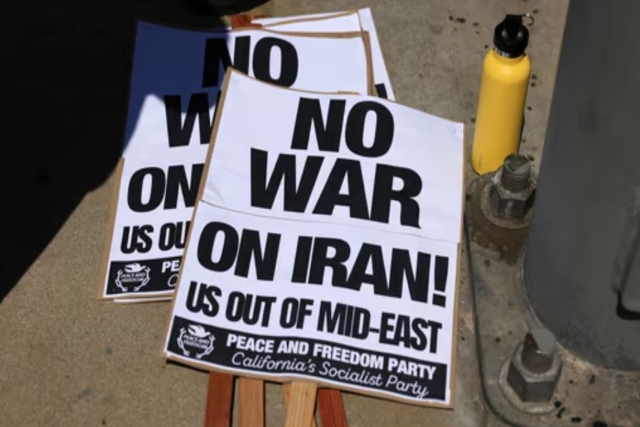
Domestic pressure is also mounting in Washington. On Tuesday, a coalition of 25 advocacy groups has urged Congress to pass a war powers resolution introduced by Senators Tim Kaine and Rand Paul. The bill would require congressional authorization before U.S. forces engage in hostilities against Iran.
“Iran has not attacked the United States nor threatened an offensive strike, and Congress has not authorized any military action against Iran,” the coalition said in a joint letter. “As a coalition of groups concerned with reckless military escalation, we urge Congress to represent its constituents, assert its Constitutional role and block an unauthorized war with Iran.”
Previous war powers resolutions have failed to advance, including after U.S. strikes last year on three Iranian nuclear facilities during a 12-day conflict between Iran and Israel. The White House at the time said the sites were “obliterated,” though subsequent reporting indicated repairs were undertaken at certain missile facilities, while major nuclear sites saw more limited restoration.
U.S. issues shipping and travel warning
The U.S. has issued guidance advising American-flagged commercial vessels to remain “as far as possible” from Iranian territorial waters. Washington recently also issued an urgent travel advisory asking its citizens to leave Iran “immediately,” signaling increasing uncertainty in the region and reflecting fears of a possible confrontation if diplomacy fails.

Iran Could Reverse-engineer Unexploded Tomahawk Missiles, GBU-57 Bombs

Iran Test-Launches Khorramshahr 4 Hypersonic Missile with 2-Ton Warhead

U.S. Shoots down Iranian Drone near Aircraft Carrier in Arabian Sea
Trump Imposes 25% Tariff on Business Done With Iran
Russia's Unmanned Systems Group Signs Several International Contracts to Sell its Supercam...
50 Killed, 500 Injured in U.S. Airstrikes Against Iranian
US Turns Israel’s Ben Gurion Airport into Forward Base for War...
Greece to Procure Aero Virionment’s Switchblade 300 Miniature Missiles
One Month Since U.S., Israeli War Against Iran: Who Is Gaining?
One month after the United States and Israel launched coordinated strikes on Iran on February 28 the conflict has expanded...
Modern Tank Showdown: T-90MS, Leopard 2A7, M1E3 Abrams Compared
Main Battle Tanks (MBTs) have shown their mettle in recent conflicts such as in Ukraine despite being increasingly vulnerable to...
European Nations Prioritizing Europe-made IRIS-T & SAMP-T over American Patriot Air Defense Systems?
European nations looking to procure new air defense systems appear to be giving the much-vaunted American Patriot a miss in...
Russian T-90MS Crew Discuss Future Upgrades
Defense Mirror spoke with the crew members of the Russian T-90MS main battle tank, produced by UralVagonZavod

China's Mass-produced J-35A Aircraft Set to Disrupt Global Stealth Fighter Market
China is aiming to disrupt the global stealth fighter market by mass-producing its fifth-generation J-35A at a pace comparable to...

The Future of Combat: Miniaturized Laser Weapons Set to Replace Bullets and Missiles
Lasers may soon replace bullets, and drones could disable enemy UAVs with beams of light instead of missiles