Chinese J-10C Fighter Evolves into a Network-Centric Warfare Node
Integration with early warning aircraft, air defense systems highlighted during recent PLA drills
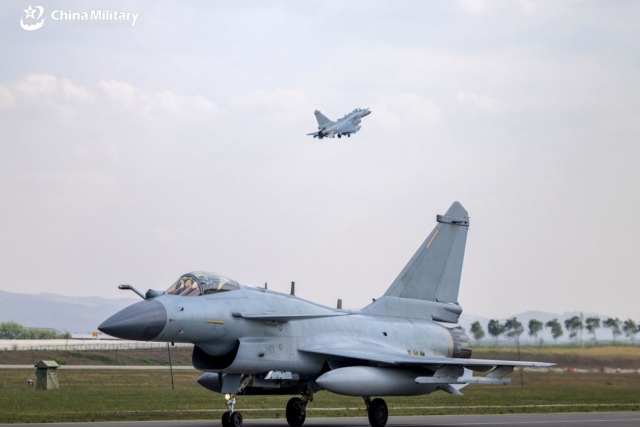
The Chinese People’s Liberation Army (PLA) Air Force’s J-10C fighter jet has transitioned from a stand-alone platform into a networked warfare node, sharing targeting data with airborne early warning aircraft and ground-based air defense systems.
State-controlled CCTV News reported that recent high-intensity drills involving J-10C units were conducted under complex electromagnetic conditions, coinciding with the 28th anniversary of the aircraft’s maiden flight. The exercises included confrontational combat, close-range dogfights, and penetration strike training.
Footage released by CCTV showed multiple J-10C fighters taking off in sequence and operating within an early warning-supported combat network in a contested electromagnetic environment. During the drills, aircraft shifted between beyond-visual-range engagements, mid-range combat, and close-range dogfights, while alternating between offensive and defensive roles.
According to CCTV Military, regular joint training now involves coordination between the J-10C and airborne early warning systems, as well as ground-based air defense, radar, and electronic warfare units. This reflects increasing integration among platforms as newer equipment is introduced.
Chinese military affairs expert Zhang Junshe told the Global Times that the evolution of the J-10C reflects a shift toward “system-of-systems” warfare, where multiple platforms operate in an integrated manner aligned with real combat conditions. He said coordination with aircraft such as the KJ-500 early warning platform enables detection of aerial targets at long range, with data on position, speed, and altitude transmitted to fighters via data links.
Zhang explained that this allows the J-10C to approach targets while keeping its radar emissions low, activating onboard systems only at closer range to confirm and engage. He added that coordination with ground-based air defense systems enables two-way data sharing, where ground radars can guide fighters toward low-altitude threats, while fighters can pass targeting information back to air defense units.
This exchange of information creates a combined air and ground operational framework, supporting both offensive and defensive missions. Zhang said such integration enhances survivability and improves coordinated operations for airspace defense.

India’s Regional Jet Competition Hots Up- Adani-Embraer E175 against HAL-Russia’s SSJ-100...
With Air-to-Air Refueling of J-10C Aircraft, PLAAF Progressing Towards Strategic Force: Chinese...

Russian SJ-100 Civil Commuter Jet to be Manufactured in India- HAL, Russian...
Indonesia to Acquire J-10C Fighters from China, Defense Minister Says
Canada to Join GCAP Sixth Gen Fighter program as Observer
Commissioning of Taiwan’s First Indigenous Submarine Within Next 2 Months

US Armed Forces Members to Undergo Testing for Testosterone Levels
Rafale Jet Combines with Electronic Warfare Payload-Carrying UAV to Strike Simulated Target

One Month Since U.S., Israeli War Against Iran: Who Is Gaining?
One month after the United States and Israel launched coordinated strikes on Iran on February 28 the conflict has expanded...
Modern Tank Showdown: T-90MS, Leopard 2A7, M1E3 Abrams Compared
Main Battle Tanks (MBTs) have shown their mettle in recent conflicts such as in Ukraine despite being increasingly vulnerable to...
European Nations Prioritizing Europe-made IRIS-T & SAMP-T over American Patriot Air Defense Systems?
European nations looking to procure new air defense systems appear to be giving the much-vaunted American Patriot a miss in...
Russian T-90MS Crew Discuss Future Upgrades
Defense Mirror spoke with the crew members of the Russian T-90MS main battle tank, produced by UralVagonZavod

China's Mass-produced J-35A Aircraft Set to Disrupt Global Stealth Fighter Market
China is aiming to disrupt the global stealth fighter market by mass-producing its fifth-generation J-35A at a pace comparable to...

The Future of Combat: Miniaturized Laser Weapons Set to Replace Bullets and Missiles
Lasers may soon replace bullets, and drones could disable enemy UAVs with beams of light instead of missiles